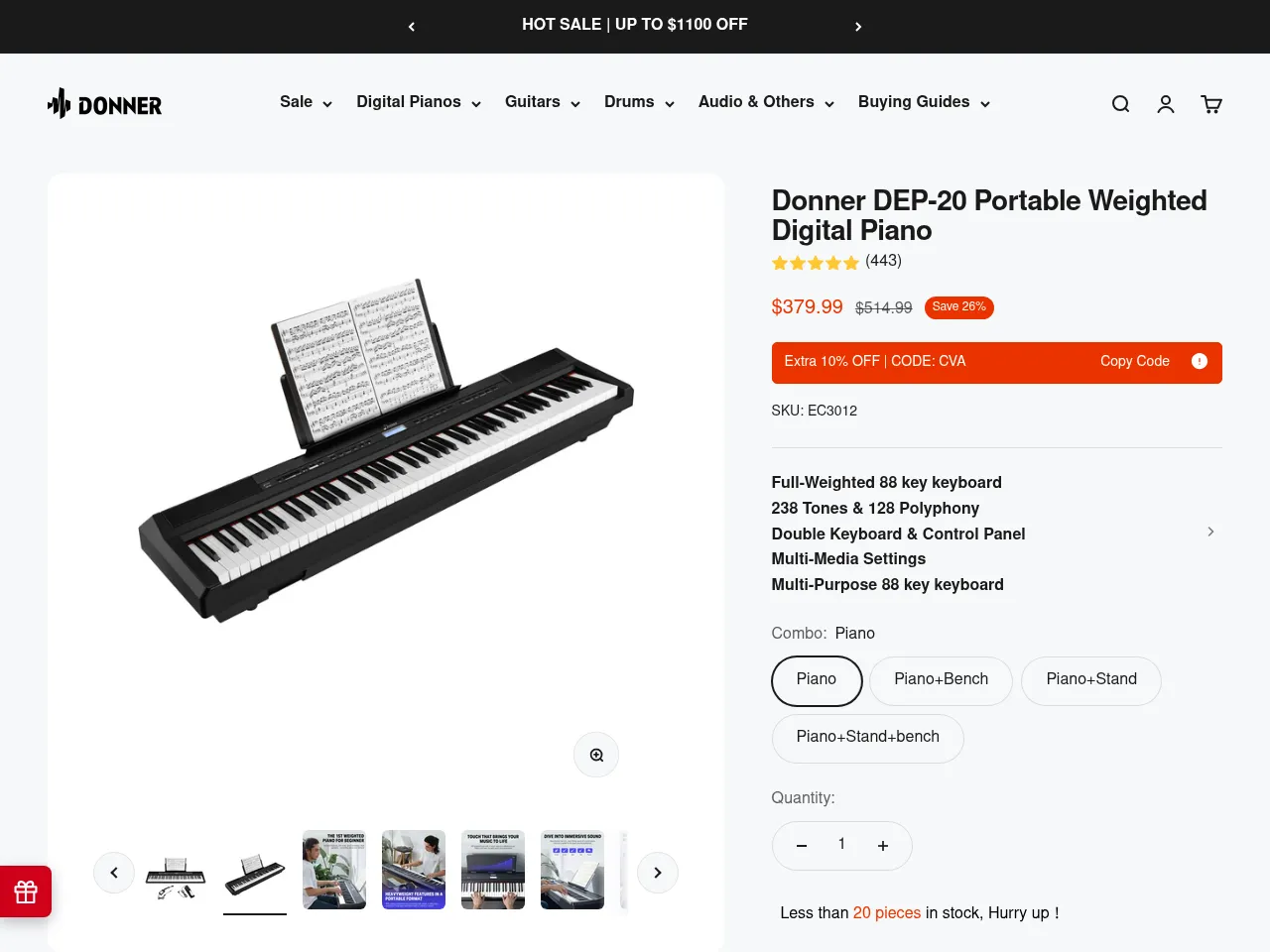
Donner DEP-20
Visão Geral
Pianos Digitais
Um piano digital de 88 teclas com preço acessível com teclas de ação martelo progressiva e 238 timbres que oferece um instrumento de prática acessível com conectividade MIDI USB e jacks para fones de ouvido duplos para aulas.
Detalhes do Instrumento
The Donner DEP-20 disrupts the entry-level market by offering a full-size, hammer-action experience at a price point where most competitors provide only semi-weighted keys. For the budget-conscious student, the weighted action is the primary selling point; it's surprisingly substantial, though it lacks the nuanced escapement and smooth damping of a high-end Roland or Yamaha. There is a noticeable mechanical 'thump' upon key release, but for developing finger strength, it's a massive step up from a basic keyboard. Sonically, the DEP-20 punches above its weight with a 128-note polyphony that handles dense pedal work without voice stealing"a rarity in this bracket. The primary grand piano sample is bright and serviceable, though it lacks the complex harmonic overtones found in more expensive modeling engines. While the 238 onboard voices offer variety, many of the non-piano sounds feel like legacy MIDI patches. The dual 25W speakers are a highlight, providing enough headroom to fill a room without distorting. The build is predominantly plastic but feels rigid enough for home use. The inclusion of a backlit LCD screen makes navigation far more intuitive than the 'hidden' key commands found on the Yamaha P-45. It's an ideal 'first piano' for students where value is the primary driver. Just plan on upgrading the included sustain pedal almost immediately.
The Donner DEP-20 occupies the absolute budget end of the 88-key weighted digital piano market, and while it delivers on the basic promise of providing full-size weighted keys at a minimal price, the compromises at this level are significant. The progressive hammer action provides graduated weight from bass to treble, which is the minimum requirement for developing proper piano technique, but the mechanism feels lighter and less substantial than keyboards from Yamaha, Casio, or Roland at higher price points. The keystroke lacks the depth and resistance that trains finger strength and control effectively. The piano sounds are acceptable for casual playing and basic practice -- clean and reasonably warm -- but they lack the dynamic range and tonal complexity that make practice musically engaging. Playing softly and loudly does not reveal the same range of tonal change that better sound engines provide. The 238 additional voices and 200 rhythms add variety but are of modest quality. The dual headphone jacks for lesson use and USB MIDI connectivity are practical inclusions. The built-in speakers are adequate for quiet personal practice. For absolute beginners on the tightest possible budget who need an 88-key weighted instrument to start learning, the DEP-20 provides a functional starting point. However, intermediate and serious students should save for a more capable instrument, as the DEP-20's action and sound quality will become limiting factors relatively early in the learning journey.
 Powered by Rexiew