Harps - Directory w/ AI Reviews
Lever harps, pedal harps, and celtic harps
The harp is one of the oldest known instruments, featuring strings stretched between a neck and a soundboard that are plucked with the fingers. Concert (pedal) harps typically have 47 strings spanning nearly seven octaves, while smaller lever harps are more portable and accessible. The harp produces a shimmering, ethereal sound that is unmistakable in any musical setting.
History
Harps appear in archaeological records dating back over 5,000 years, from ancient Mesopotamia and Egypt. The concert pedal harp was developed by Sebastien Erard in 1810, using a double-action pedal mechanism that allows the harp to play in any key. Celtic lever harps (clarsach) have experienced a revival since the 20th century, becoming popular in folk, new age, and therapeutic music.
Characteristics
Concert harps use seven foot pedals to change the pitch of each note by a semitone or whole tone, enabling chromatic playing. The strings progress diatonically, with color coding (red for C, blue or black for F) to help the player navigate. Harp technique involves plucking strings with the thumbs and first three fingers of both hands, with the pinky fingers never used.
Notable Players
Marcel Grandjany and Carlos Salzedo defined modern harp technique and pedagogy in the 20th century. Harpo Marx brought the harp into popular culture through his comedic yet genuinely skilled performances. Joanna Newsom is a contemporary harpist and singer-songwriter who has brought the instrument into indie and alternative music.
Fun Facts
A concert harp weighs about 80 pounds and stands approximately 6 feet tall, making it one of the largest orchestral instruments. The total string tension on a concert harp is approximately 2,000 pounds, comparable to the tension on a grand piano despite having far fewer strings.
 1
4.9
1
4.9
 Lyon & Healy Style 85 Concert Grand Pedal Harp
Lyon & Healy
$32,000
Professional
United States
One of the world's most revered concert grand pedal harps with 47 strings, Sitka spruce soundboard, and gold leaf ornamentation, delivering magnificent tone for professional orchestral performance.
Lyon & Healy Style 85 Concert Grand Pedal Harp
Lyon & Healy
$32,000
Professional
United States
One of the world's most revered concert grand pedal harps with 47 strings, Sitka spruce soundboard, and gold leaf ornamentation, delivering magnificent tone for professional orchestral performance.
 2
4.8
2
4.8
 Dusty Strings FH36S Lever Harp
Dusty Strings
$5,295
Advanced
United States
A premium 36-string lever harp handcrafted in Seattle with solid spruce soundboard and Loveland levers, producing a warm, rich sound with remarkable projection that has earned a devoted following among Celtic and folk harpists.
Dusty Strings FH36S Lever Harp
Dusty Strings
$5,295
Advanced
United States
A premium 36-string lever harp handcrafted in Seattle with solid spruce soundboard and Loveland levers, producing a warm, rich sound with remarkable projection that has earned a devoted following among Celtic and folk harpists.
 3
4.8
3
4.8
 Salvi Daphne 47SE Pedal Harp
Salvi
$28,000
Professional
Italy
Professional 47-string concert pedal harp with hand-graduated spruce soundboard and smooth pedal action, delivering lush tone for orchestral and solo performance.
Salvi Daphne 47SE Pedal Harp
Salvi
$28,000
Professional
Italy
Professional 47-string concert pedal harp with hand-graduated spruce soundboard and smooth pedal action, delivering lush tone for orchestral and solo performance.
 4
4.7
4
4.7
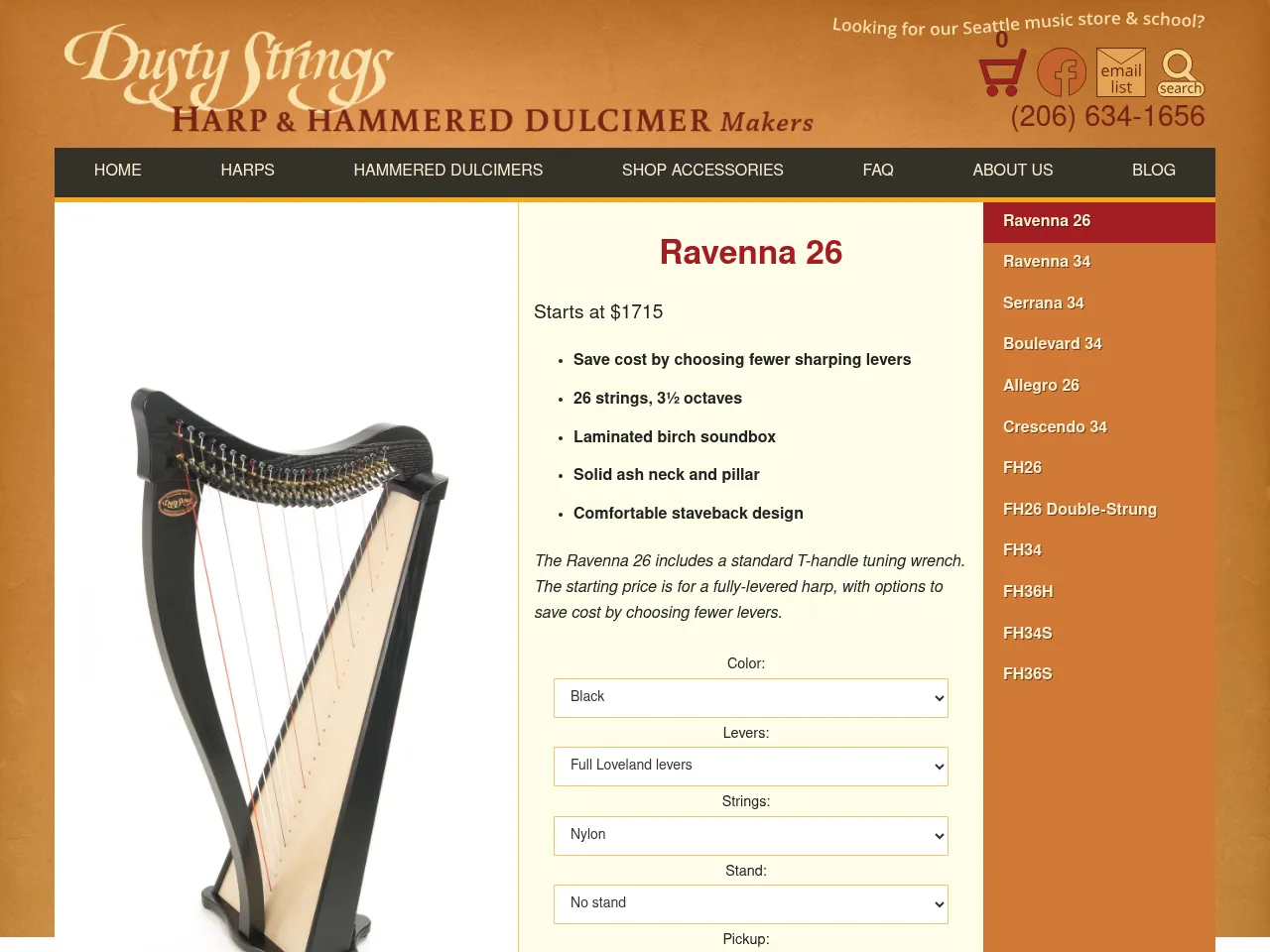
 Dusty Strings Ravenna 26 Lever Harp
Dusty Strings
$1,995
Beginner
United States
A 26-string lever harp that serves as an excellent entry point into lever harp playing, with a sweet, clear tone and compact, portable design that is practical for traveling harpists and beginning students.
Dusty Strings Ravenna 26 Lever Harp
Dusty Strings
$1,995
Beginner
United States
A 26-string lever harp that serves as an excellent entry point into lever harp playing, with a sweet, clear tone and compact, portable design that is practical for traveling harpists and beginning students.
 5
4.7
5
4.7
 Lyon & Healy Ogden Lever Harp
Lyon & Healy
$6,800
Intermediate
United States
A 34-string lever harp bringing legendary Lyon & Healy tone and craftsmanship to the lever harp market, with bright, projecting sound and reliable Truitt lever mechanisms.
Lyon & Healy Ogden Lever Harp
Lyon & Healy
$6,800
Intermediate
United States
A 34-string lever harp bringing legendary Lyon & Healy tone and craftsmanship to the lever harp market, with bright, projecting sound and reliable Truitt lever mechanisms.
 6
4.7
6
4.7
 Lyon & Healy Prelude 40 Lever Harp
Lyon & Healy
$5,495
Intermediate
United States
A 40-string lever harp covering the full range of standard lever harp repertoire, with Loveland levers on all strings and the characteristic Lyon & Healy clarity and projection.
Lyon & Healy Prelude 40 Lever Harp
Lyon & Healy
$5,495
Intermediate
United States
A 40-string lever harp covering the full range of standard lever harp repertoire, with Loveland levers on all strings and the characteristic Lyon & Healy clarity and projection.
 7
4.7
7
4.7
 Ravenna 34 Lever Harp
Lyon & Healy
$3,150
Beginner
United States
Lyon & Healy's entry-level 34-string lever harp with laminated maple body and Truitt levers, offering full chromatic capability at an accessible price.
Ravenna 34 Lever Harp
Lyon & Healy
$3,150
Beginner
United States
Lyon & Healy's entry-level 34-string lever harp with laminated maple body and Truitt levers, offering full chromatic capability at an accessible price.
 8
4.7
8
4.7
 Rees Aberdeen Meadow Lever Harp
Rees
$5,100
Intermediate
United States
Handcrafted American 36-string lever harp from Rising Sun, Indiana, with solid spruce soundboard and cherry body producing warm, intimate tone.
Rees Aberdeen Meadow Lever Harp
Rees
$5,100
Intermediate
United States
Handcrafted American 36-string lever harp from Rising Sun, Indiana, with solid spruce soundboard and cherry body producing warm, intimate tone.
 9
4.7
9
4.7
 Salvi Ana Lever Harp
Salvi
$5,500
Intermediate
Italy
Beautifully crafted 38-string lever harp with solid spruce soundboard and quiet Camac levers, bridging student and professional instruments with warm, singing tone.
Salvi Ana Lever Harp
Salvi
$5,500
Intermediate
Italy
Beautifully crafted 38-string lever harp with solid spruce soundboard and quiet Camac levers, bridging student and professional instruments with warm, singing tone.
 10
4.4
10
4.4
 Harpsicle Special Edition 26-String Harp
Harpsicle
$399
Beginner
United States
A charming 26-string lap harp that has introduced thousands to harp playing through approachable size and sweet bell-like tone, with sharping levers on all strings and weighing just over five pounds.
Harpsicle Special Edition 26-String Harp
Harpsicle
$399
Beginner
United States
A charming 26-string lap harp that has introduced thousands to harp playing through approachable size and sweet bell-like tone, with sharping levers on all strings and weighing just over five pounds.