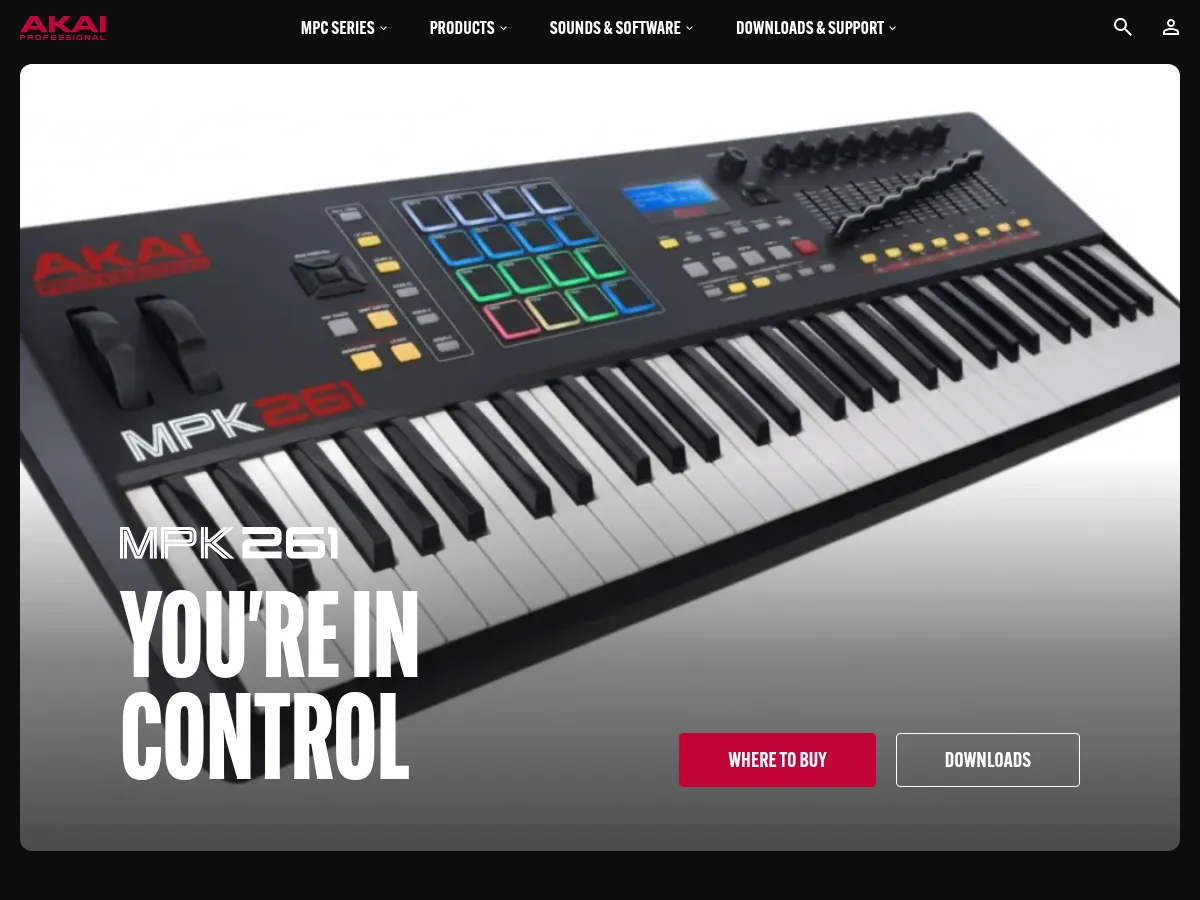
Akai MPK261
Überblick
MIDI-Controller
Der Akai MPK261 ist ein umfassender 61-Tasten-MIDI-Controller mit halbgewichteten Tasten, 16 MPC Pads, 24 Drehreglern, acht Fadern und CV/Gate-Ausgängen und bietet damit ein komplettes Kontrollzentrum für Studio-Produzenten, die manuelle Kontrolle über ihre DAW benötigen.
Instrumentendetails
The Akai MPK261 remains a benchmark for professional-grade MIDI controllers, even a decade after its debut. Its 'tank-like' build quality is immediately apparent; this is a heavy, road-ready unit that stays planted during aggressive performances. The semi-weighted keybed strikes a satisfying balance between synth-action speed and piano-like resistance, and the inclusion of channel aftertouch provides essential expressive control for modern sound design and cinematic textures.
The 16 RGB MPC pads are the gold standard, offering a level of sensitivity and tactile 'thud' that budget competitors simply can't replicate. While the faders and knobs feel robust, the workflow is the real winner here"deep DAW integration allows for a mostly mouse-free experience once configured. The main trade-off is the bulk; it's a massive footprint for a 61-key board, and the monochrome LCD screen feels dated compared to the vibrant displays on newer rivals like the Arturia KeyLab series. However, for the producer who wants a durable, all-in-one command center with genuine MPC DNA, the MPK261 is still hard to beat. It's best suited for advanced users who need a reliable workhorse for both complex studio sequencing and expressive live performance where reliability is non-negotiable.
The Akai MPK261 is a workhorse controller designed for producers who want one device to handle keys, pads, faders, and knobs without switching between multiple pieces of hardware. The 61-key semi-weighted keybed strikes a practical balance -- weighted enough to feel expressive for piano and organ parts, light enough for fast synth leads and rapid chord changes. The 16 MPC pads are excellent for finger drumming, and the extensive control surface with 24 knobs, eight faders, and eight buttons provides enough tactile control to minimize mouse interaction during production sessions. The arpeggiator and Note Repeat add creative real-time performance options that work well for both studio and stage. CV/gate outputs for hardware synth control show forward-thinking design. The metal chassis is sturdy and road-worthy, though the substantial weight and footprint mean this is not a casual purchase -- you need dedicated desk space. The keybed, while competent, is not in the same league as dedicated hammer-action controllers for serious piano playing. For producers who want a single, comprehensive controller that handles multiple duties across their DAW workflow, the MPK261 delivers solid all-around performance, though specialists in any single area -- piano players, dedicated pad performers, mixing engineers -- may prefer more focused alternatives.
 Powered by Rexiew