Tubas - Directory w/ AI Reviews
Concert tubas, sousaphones, and euphoniums
The tuba is the largest and lowest-pitched brass instrument, providing the bass foundation for orchestras, concert bands, and brass ensembles. Its deep, resonant tone can be both powerful and surprisingly gentle, supporting harmony from below. Tubas come in several sizes and keys, with the BBb and CC contrabass tubas being the most common in professional settings.
History
Wilhelm Friedrich Wieprecht and Johann Gottfried Moritz patented the first tuba in Berlin in 1835, creating a bass brass instrument with valves. The instrument rapidly replaced the ophicleide and serpent in orchestras and bands throughout the 19th century. John Philip Sousa popularized a forward-facing variant (the sousaphone) for marching bands in the early 1900s, which remains a marching staple today.
Characteristics
Tubas use three to six piston or rotary valves and feature a large, flared bell that projects sound broadly. The instrument requires a large volume of air and a relaxed, open embouchure to produce its characteristic warm, round bass tone. BBb tubas are most common in bands, while CC tubas are standard in American orchestras, and F and Eb tubas serve as smaller, higher-pitched alternatives.
Notable Players
Arnold Jacobs, principal tubist of the Chicago Symphony for 44 years, is considered the most influential tuba player and brass pedagogue in history. Oystein Baadsvik has championed the tuba as a solo instrument with his virtuosic performances and recordings. Carol Jantsch became the first female principal tubist of a major American orchestra when she joined the Philadelphia Orchestra in 2006.
Fun Facts
The tuba is the youngest instrument in the standard orchestra, having been invented over 300 years after the violin. "Tuba Christmas" concerts, where hundreds of tuba and euphonium players gather to perform holiday music, have been held annually since 1974 in cities around the world.
 1
4.8
1
4.8
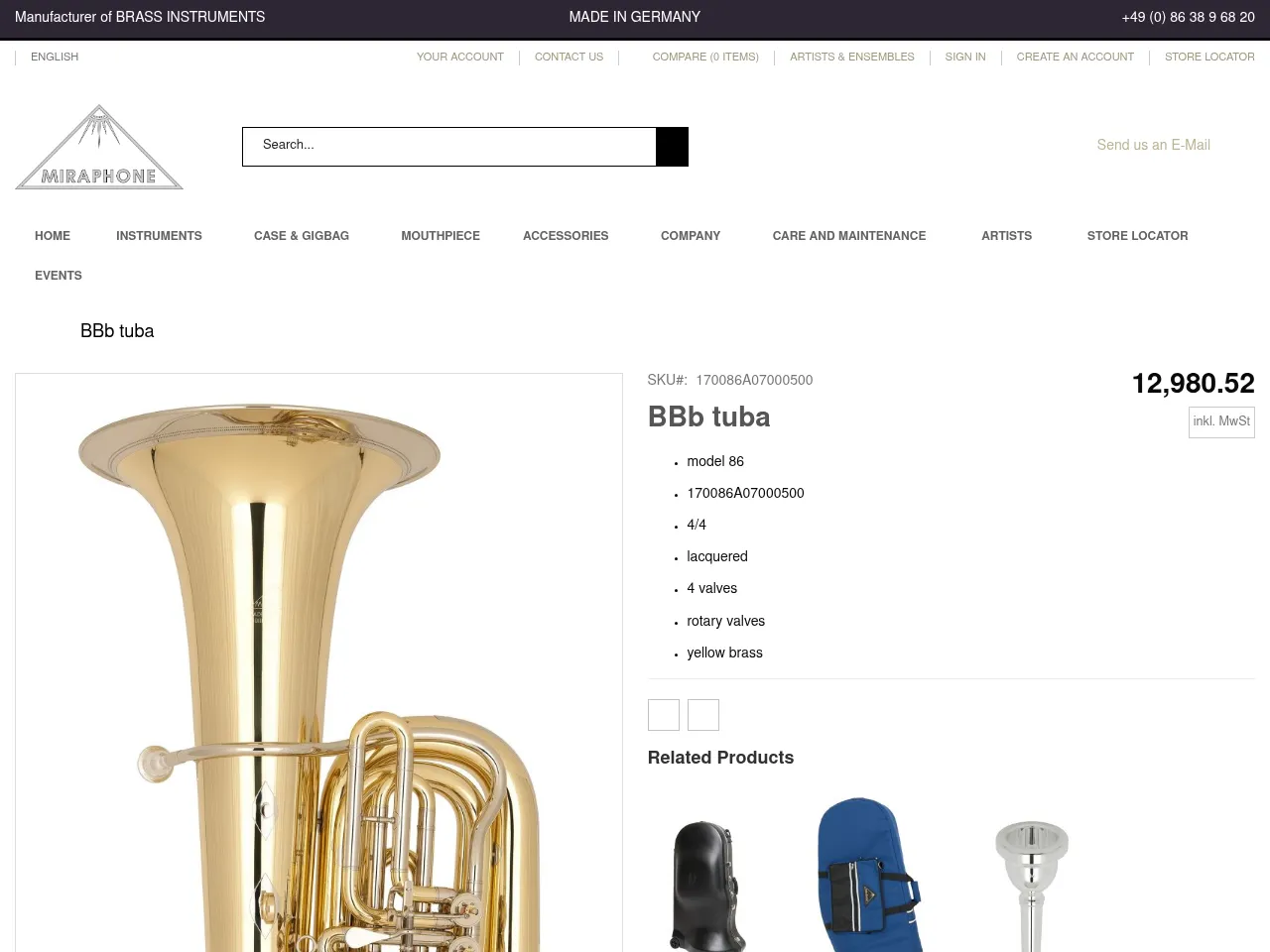
 Miraphone 186-4U Bb Tuba
Miraphone
$12,999
Professional
Germany
A professional German-crafted Bb tuba delivering massive, rich orchestral tone with four precise rotary valves, favored by professional tubists worldwide for its depth and warmth.
Miraphone 186-4U Bb Tuba
Miraphone
$12,999
Professional
Germany
A professional German-crafted Bb tuba delivering massive, rich orchestral tone with four precise rotary valves, favored by professional tubists worldwide for its depth and warmth.
 2
4.8
2
4.8
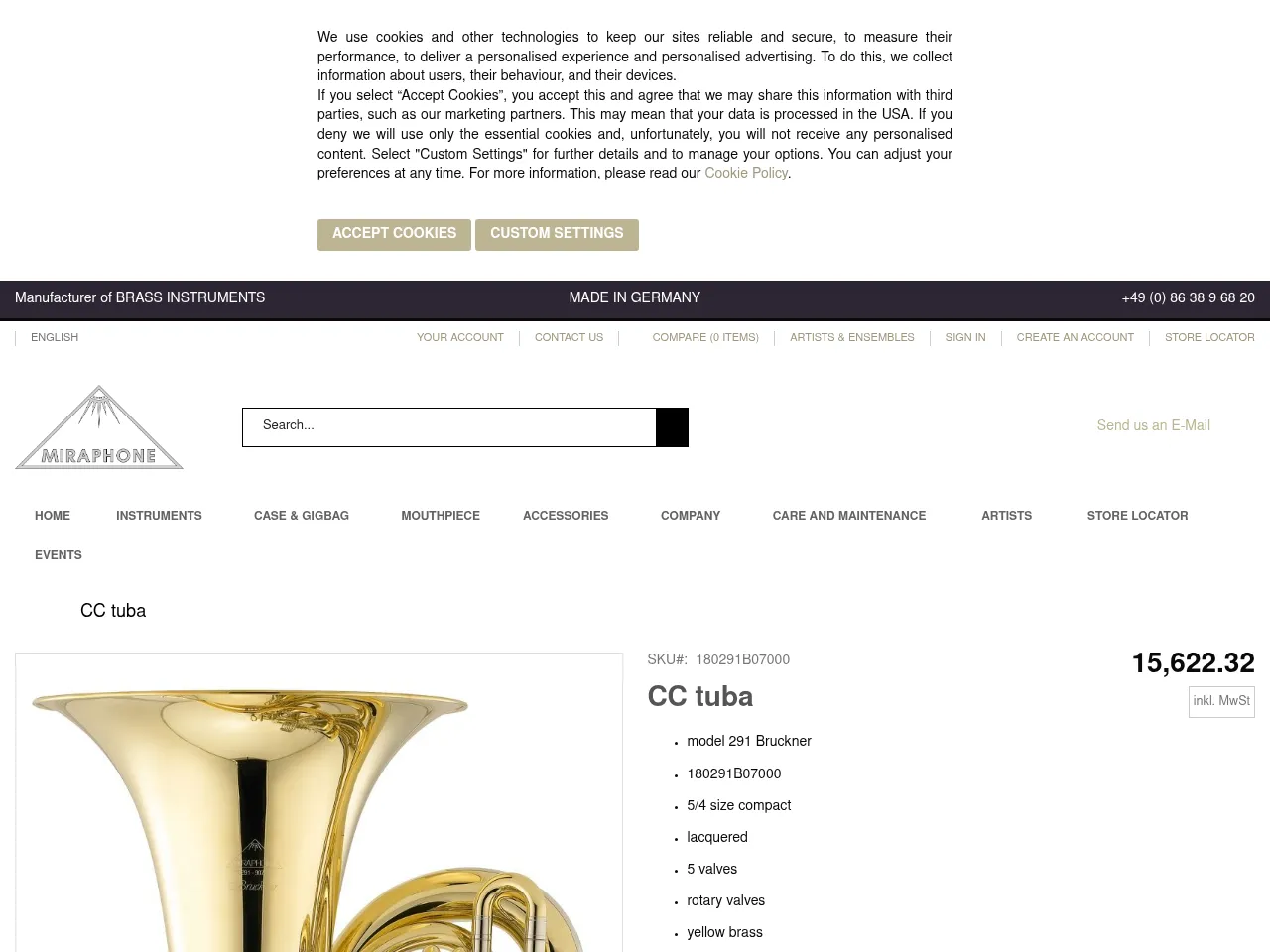
 Miraphone 291A Bruckner Professional CC Tuba
Miraphone
$12,999
Professional
Germany
A professional CC tuba that has become a standard in American orchestras, with smooth rotary valves and commanding projection balanced by responsive pianissimo capability.
Miraphone 291A Bruckner Professional CC Tuba
Miraphone
$12,999
Professional
Germany
A professional CC tuba that has become a standard in American orchestras, with smooth rotary valves and commanding projection balanced by responsive pianissimo capability.
 3
4.7
3
4.7
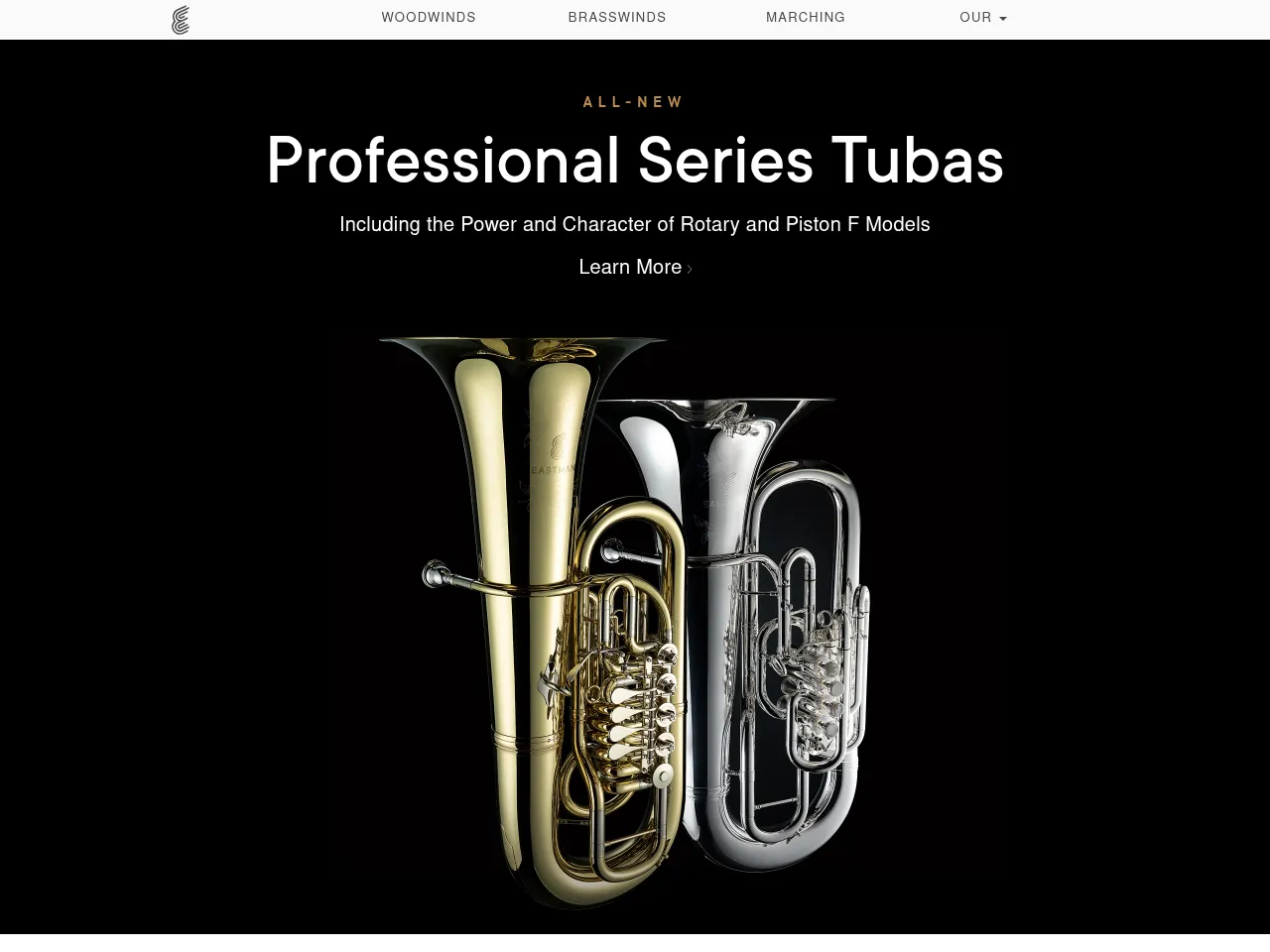
 Eastman EBB562 Professional BBb Tuba
Eastman
$5,499
Professional
China
The Eastman EBB562 is a professional BBb tuba delivering rich, full sound with excellent depth and projection at a price significantly below competing professional instruments, increasingly popular among university students.
Eastman EBB562 Professional BBb Tuba
Eastman
$5,499
Professional
China
The Eastman EBB562 is a professional BBb tuba delivering rich, full sound with excellent depth and projection at a price significantly below competing professional instruments, increasingly popular among university students.
 4
4.7
4
4.7
 Yamaha YCB-621 Professional C Tuba
Yamaha
$9,999
Professional
Japan
Professional CC tuba with four rotary valves and precise Yamaha build quality, delivering a bright, focused tone favored for American orchestral playing.
Yamaha YCB-621 Professional C Tuba
Yamaha
$9,999
Professional
Japan
Professional CC tuba with four rotary valves and precise Yamaha build quality, delivering a bright, focused tone favored for American orchestral playing.
 5
4.5
5
4.5
 Jupiter JTU1110 Intermediate BBb Tuba
Jupiter
$5,299
Intermediate
Taiwan
An intermediate four-valve BBb tuba offering advancing students a full-size instrument with smooth piston action and warm tone at a price well below professional European models.
Jupiter JTU1110 Intermediate BBb Tuba
Jupiter
$5,299
Intermediate
Taiwan
An intermediate four-valve BBb tuba offering advancing students a full-size instrument with smooth piston action and warm tone at a price well below professional European models.
 6
4.5
6
4.5
 Yamaha YBB-105WC Standard BBb Tuba
Yamaha
$3,999
Beginner
Japan
Compact student BBb tuba with front-action pistons and manageable size for younger players, providing a genuine tuba sound for beginning school band studies.
Yamaha YBB-105WC Standard BBb Tuba
Yamaha
$3,999
Beginner
Japan
Compact student BBb tuba with front-action pistons and manageable size for younger players, providing a genuine tuba sound for beginning school band studies.
 7
4.4
7
4.4
 Jupiter JTU1100M Quantum Marching BBb Tuba
Jupiter
$3,299
Intermediate
Taiwan
A purpose-built marching BBb tuba with convertible bell design and fiberglass-reinforced body, significantly lighter than traditional brass while delivering full projection for field performance.
Jupiter JTU1100M Quantum Marching BBb Tuba
Jupiter
$3,299
Intermediate
Taiwan
A purpose-built marching BBb tuba with convertible bell design and fiberglass-reinforced body, significantly lighter than traditional brass while delivering full projection for field performance.
 8
4.2
8
4.2
 Eastman EBB534 Intermediate BBb Tuba
Eastman
$4,499
Intermediate
China
The Eastman EBB534 is an intermediate BBb tuba delivering impressive performance at an accessible price, with four piston valves, warm tone, and solid construction making quality tuba playing available to advancing students.
Eastman EBB534 Intermediate BBb Tuba
Eastman
$4,499
Intermediate
China
The Eastman EBB534 is an intermediate BBb tuba delivering impressive performance at an accessible price, with four piston valves, warm tone, and solid construction making quality tuba playing available to advancing students.