Trombones - Directory w/ AI Reviews
Tenor trombones, bass trombones, and valve trombones
The trombone is a brass instrument that uses a telescoping slide instead of valves to change pitch, giving it a uniquely smooth, singing quality. Its rich, powerful tone makes it a staple of orchestras, jazz ensembles, concert bands, and brass sections in pop and funk. The trombone's slide allows for continuous pitch changes (glissando), a technique unique among brass instruments.
History
The trombone (originally called the "sackbut") emerged in the 15th century and is one of the oldest brass instruments still in regular use. It was a fixture of church and ceremonial music throughout the Renaissance and Baroque periods. Jazz trombonists like Jack Teagarden and J.J. Johnson transformed the instrument into a fluid solo voice in the 20th century.
Characteristics
The slide trombone has seven slide positions that, combined with different lip tensions (partials), produce a full chromatic range. Tenor trombones are the most common, while bass trombones feature larger bells and additional valves for extended low range. The slide enables perfectly smooth glissandos and precise intonation adjustments that are impossible on valved brass instruments.
Notable Players
J.J. Johnson was the first trombonist to fully adapt the instrument to the demands of bebop jazz, proving it could match the agility of trumpets and saxophones. Tommy Dorsey's silky-smooth tone earned him the nickname "The Sentimental Gentleman of Swing." Christian Lindberg has been called the world's first full-time solo trombonist, commissioning over 300 new works for the instrument.
Fun Facts
The trombone is the only orchestral brass instrument that can play a true glissando, sliding smoothly between notes without any steps. In medieval times, trombones were considered the instrument closest to the human voice and were regularly used to double vocal parts in church music.
 1
4.8
1
4.8
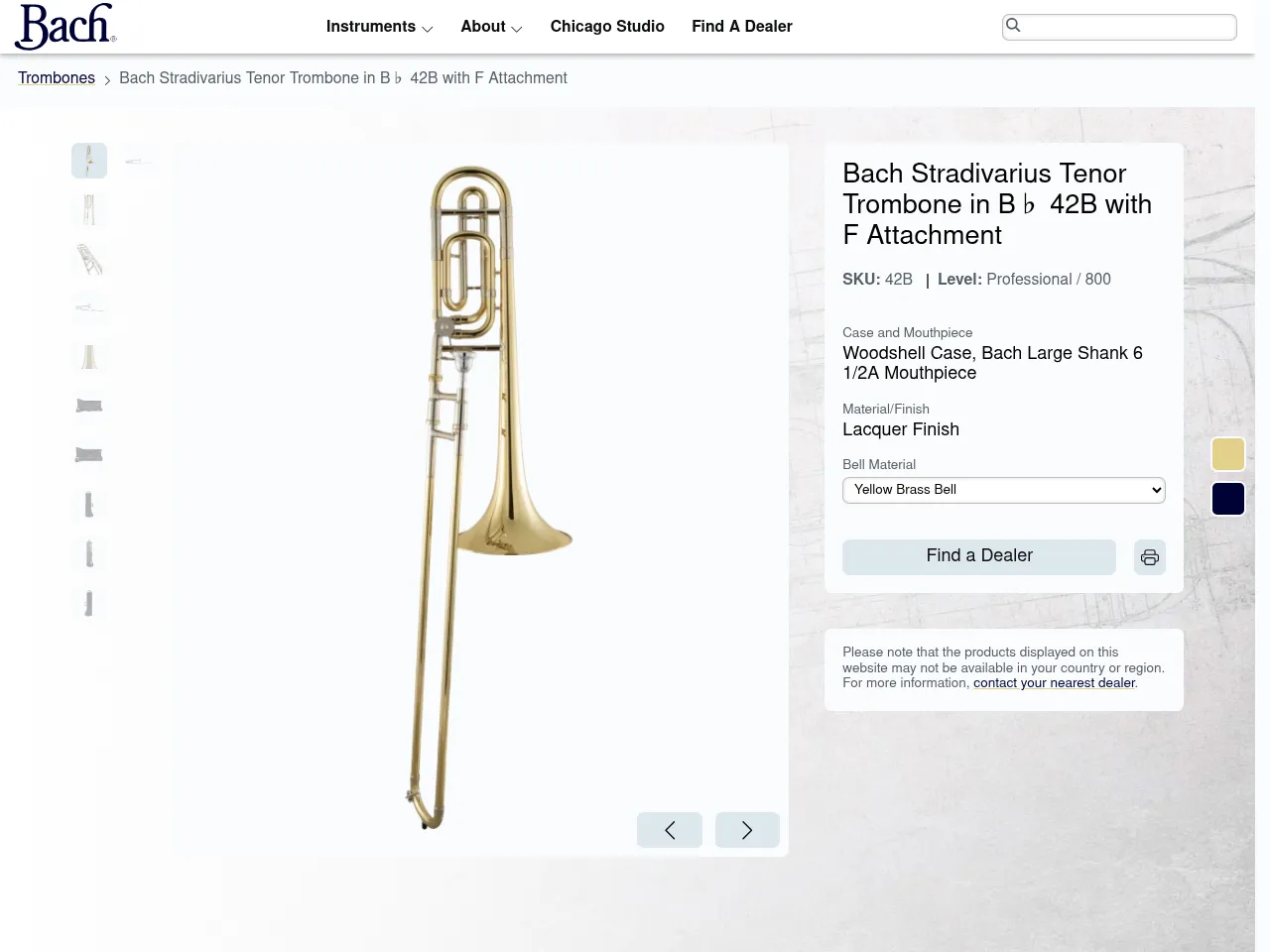
 Bach 42B Stradivarius Professional Bb/F Tenor Trombone
Bach
$3,799
Professional
United States
The Bach 42B Stradivarius is a professional tenor trombone with F attachment that has been a mainstay in symphony orchestras for decades, delivering rich, powerful sound through its hand-hammered bell and smooth open-wrap F section.
Bach 42B Stradivarius Professional Bb/F Tenor Trombone
Bach
$3,799
Professional
United States
The Bach 42B Stradivarius is a professional tenor trombone with F attachment that has been a mainstay in symphony orchestras for decades, delivering rich, powerful sound through its hand-hammered bell and smooth open-wrap F section.
 2
4.8
2
4.8
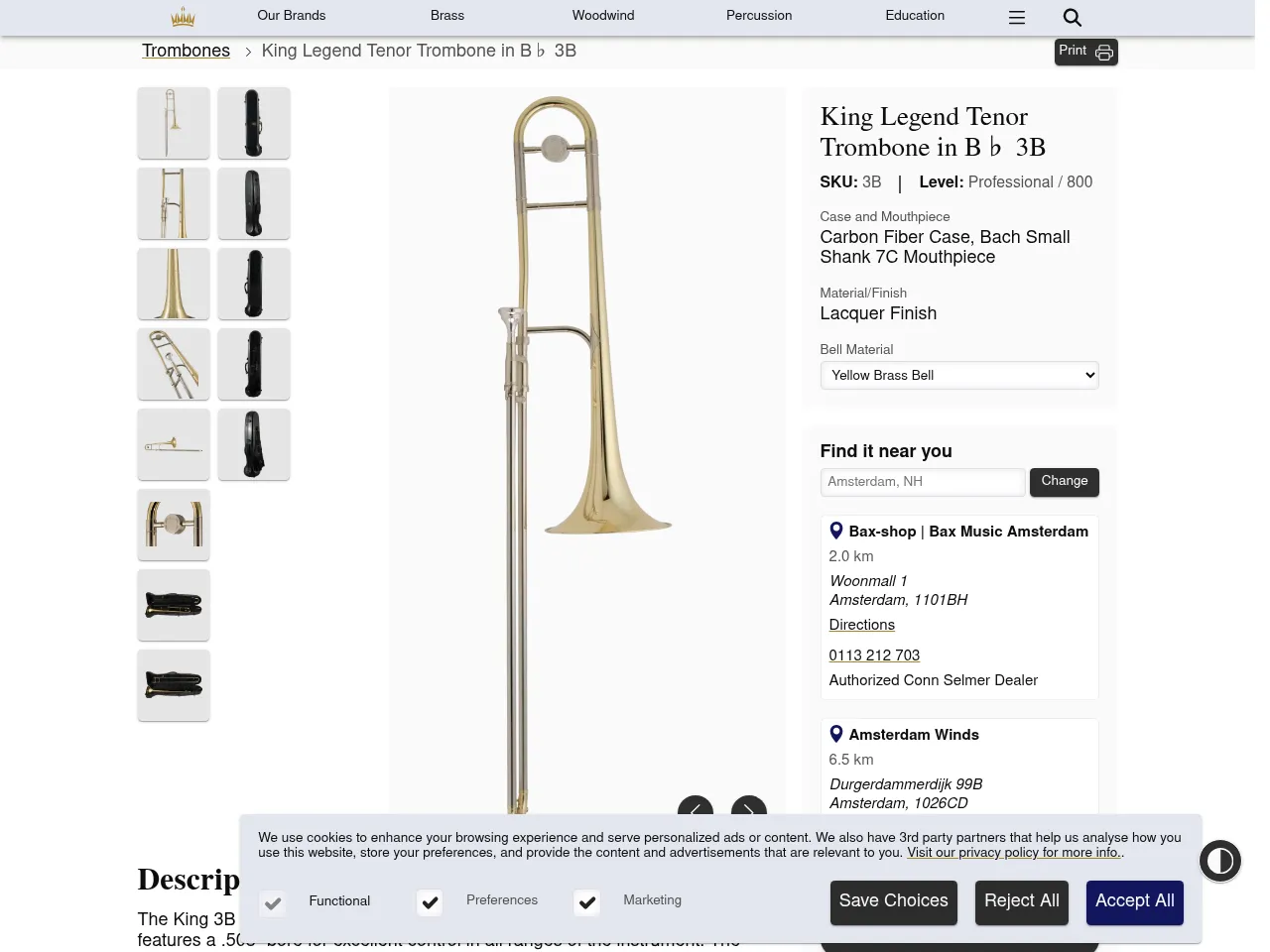
 King 2103 3B Legend Professional Bb Tenor Trombone
King
$2,999
Professional
USA
A legendary jazz trombone with medium bore and bright projection that has shaped the genre for generations, delivering the agility and cutting tone demanded by jazz and commercial players.
King 2103 3B Legend Professional Bb Tenor Trombone
King
$2,999
Professional
USA
A legendary jazz trombone with medium bore and bright projection that has shaped the genre for generations, delivering the agility and cutting tone demanded by jazz and commercial players.
 3
4.8
King 2103F Jiggs Whigham Professional Bb/F Tenor Trombone
King
$2,499
Professional
United States
A professional Bb/F tenor trombone designed with jazz legend Jiggs Whigham, featuring medium bore, nickel silver slide, and the characteristically bright King sound for jazz and commercial work.
3
4.8
King 2103F Jiggs Whigham Professional Bb/F Tenor Trombone
King
$2,499
Professional
United States
A professional Bb/F tenor trombone designed with jazz legend Jiggs Whigham, featuring medium bore, nickel silver slide, and the characteristically bright King sound for jazz and commercial work.
 4
4.8
4
4.8
 Yamaha YSL-354 Standard Bb Tenor Trombone
Yamaha
$1,299
Beginner
Japan
Gold-standard student tenor trombone with smooth chrome slide and accurate intonation, trusted by band directors worldwide as the most reliable beginner trombone available.
Yamaha YSL-354 Standard Bb Tenor Trombone
Yamaha
$1,299
Beginner
Japan
Gold-standard student tenor trombone with smooth chrome slide and accurate intonation, trusted by band directors worldwide as the most reliable beginner trombone available.
 5
4.8
5
4.8
 Yamaha YSL-882O Xeno Professional Bb/F Tenor Trombone
Yamaha
$4,499
Professional
Japan
Flagship Xeno professional trombone developed with leading players, featuring a hand-hammered bell and impeccable build quality for world-class orchestral and ensemble performance.
Yamaha YSL-882O Xeno Professional Bb/F Tenor Trombone
Yamaha
$4,499
Professional
Japan
Flagship Xeno professional trombone developed with leading players, featuring a hand-hammered bell and impeccable build quality for world-class orchestral and ensemble performance.
 6
4.8
6
4.8
 Bach 42BO Stradivarius Professional Bb/F Tenor Trombone
Bach
$4,999
Professional
USA
The Bach 42BO Stradivarius stands as one of the most widely used professional trombones in orchestras worldwide, with its large bore and hand-hammered bell producing rich, dark tone with massive projection that fills concert halls.
Bach 42BO Stradivarius Professional Bb/F Tenor Trombone
Bach
$4,999
Professional
USA
The Bach 42BO Stradivarius stands as one of the most widely used professional trombones in orchestras worldwide, with its large bore and hand-hammered bell producing rich, dark tone with massive projection that fills concert halls.
 7
4.7
7
4.7
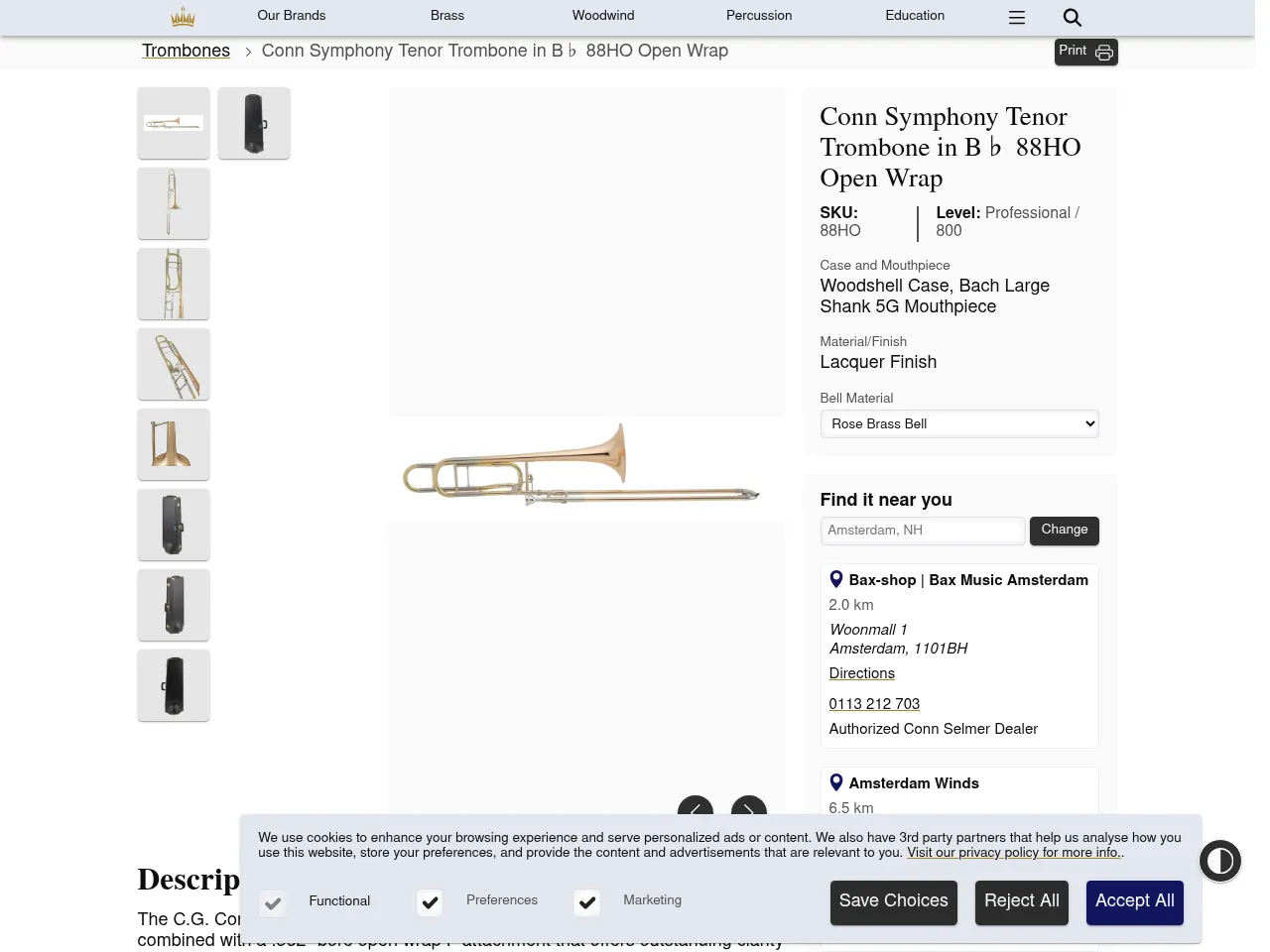
 Conn 88HO Symphony Professional Bb/F Tenor Trombone
Conn
$4,799
Professional
USA
The Conn 88H is one of the most iconic orchestral trombones ever made, with its rose brass bell producing a distinctly darker, warmer tone that has defined the American orchestral trombone sound for generations.
Conn 88HO Symphony Professional Bb/F Tenor Trombone
Conn
$4,799
Professional
USA
The Conn 88H is one of the most iconic orchestral trombones ever made, with its rose brass bell producing a distinctly darker, warmer tone that has defined the American orchestral trombone sound for generations.
 8
4.7
8
4.7
 Getzen 1047F Eterna Professional Bb/F Tenor Trombone
Getzen
$3,799
Professional
USA
A professional Bb/F trombone handcrafted in Wisconsin with open-wrap F attachment and hand-lapped rotary valve, delivering a bright, focused tone with exceptional projection favored by American players.
Getzen 1047F Eterna Professional Bb/F Tenor Trombone
Getzen
$3,799
Professional
USA
A professional Bb/F trombone handcrafted in Wisconsin with open-wrap F attachment and hand-lapped rotary valve, delivering a bright, focused tone with exceptional projection favored by American players.
 9
4.6
9
4.6
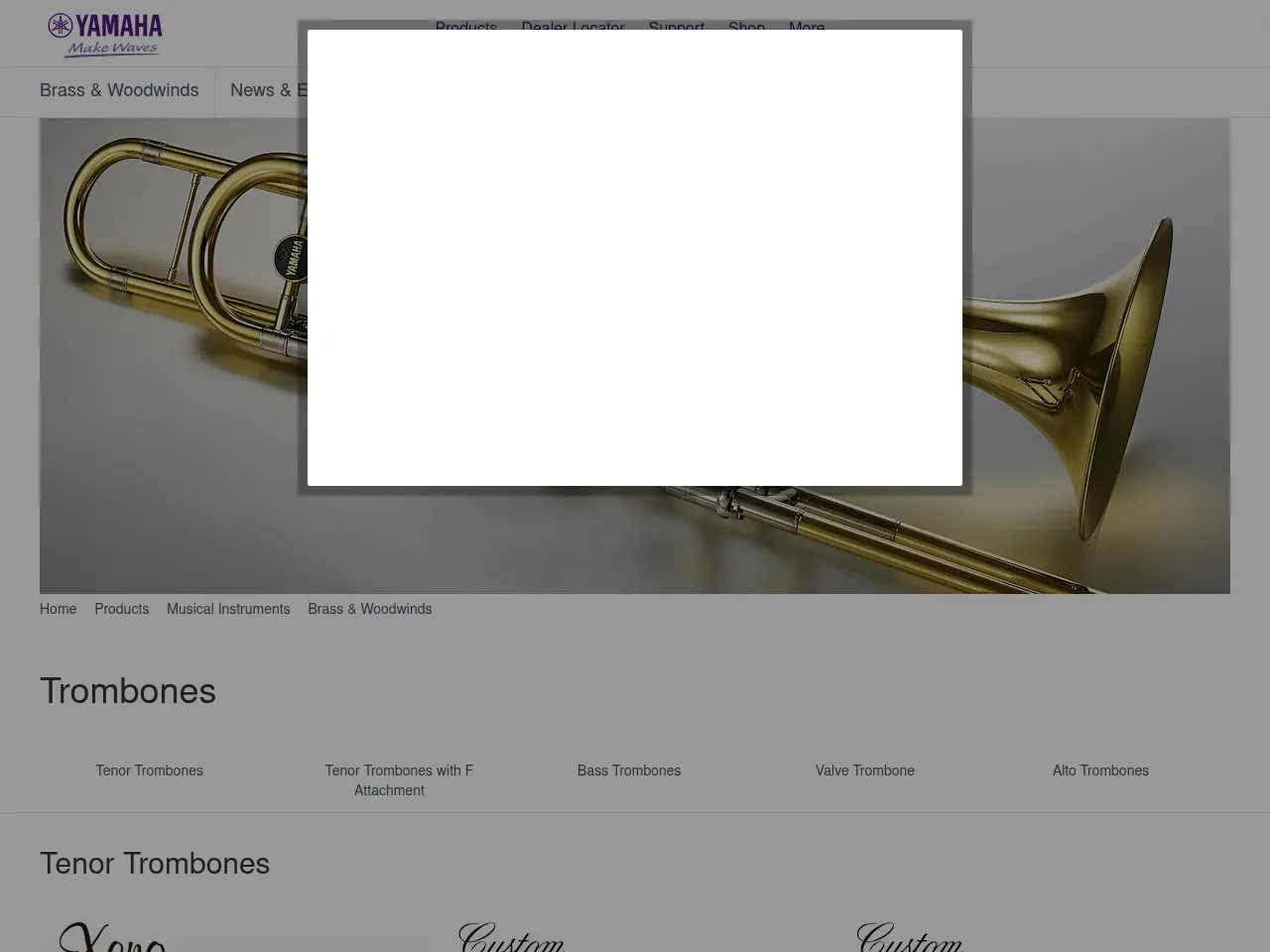
 Yamaha YSL-446G Intermediate Bb/F Tenor Trombone
Yamaha
$1,799
Intermediate
Japan
Intermediate Bb/F tenor trombone with a warm gold brass bell and F attachment, providing a meaningful upgrade for advancing students tackling more complex repertoire.
Yamaha YSL-446G Intermediate Bb/F Tenor Trombone
Yamaha
$1,799
Intermediate
Japan
Intermediate Bb/F tenor trombone with a warm gold brass bell and F attachment, providing a meaningful upgrade for advancing students tackling more complex repertoire.
 10
4.6
10
4.6
 Yamaha YSL-620 Professional Bb/F Tenor Trombone
Yamaha
$2,999
Professional
Japan
Professional Bb/F tenor trombone with open-wrap F attachment and precise slide tolerances, delivering warm centered tone with Yamaha's renowned manufacturing consistency.
Yamaha YSL-620 Professional Bb/F Tenor Trombone
Yamaha
$2,999
Professional
Japan
Professional Bb/F tenor trombone with open-wrap F attachment and precise slide tolerances, delivering warm centered tone with Yamaha's renowned manufacturing consistency.
 11
4.4
11
4.4
 Jupiter JTB1100F Intermediate Bb/F Tenor Trombone
Jupiter
$2,199
Intermediate
Taiwan
An intermediate Bb/F trombone with open-wrap F attachment and smooth chrome slide, bridging student and professional instruments with a full, warm tone suited for advancing players and community ensembles.
Jupiter JTB1100F Intermediate Bb/F Tenor Trombone
Jupiter
$2,199
Intermediate
Taiwan
An intermediate Bb/F trombone with open-wrap F attachment and smooth chrome slide, bridging student and professional instruments with a full, warm tone suited for advancing players and community ensembles.
 12
3.9
12
3.9
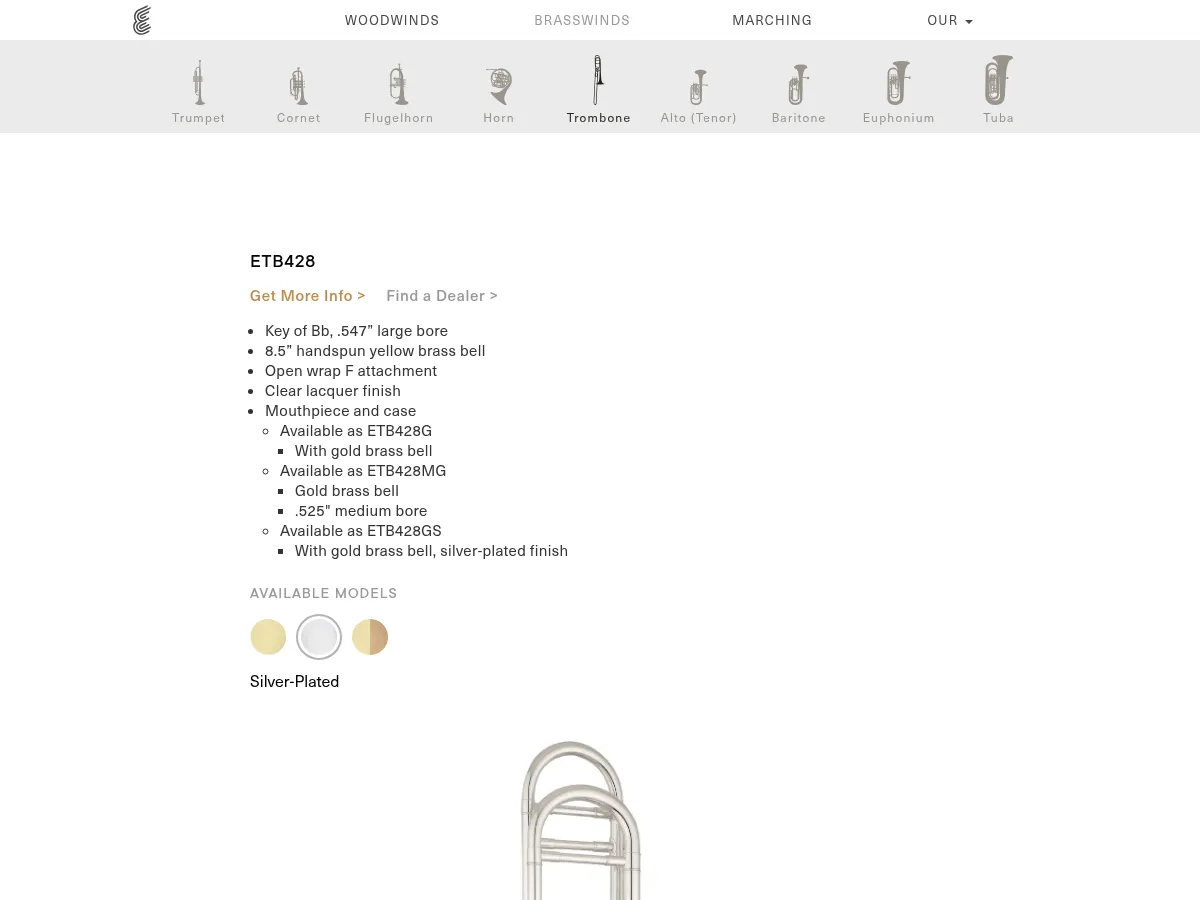
 Eastman ETB428 Student Bb Tenor Trombone
Eastman
$599
Beginner
China
The Eastman ETB428 is a student Bb tenor trombone offering surprising quality at an accessible price, with a smooth chrome inner slide and centered tone providing a solid foundation for beginning trombone students.
Eastman ETB428 Student Bb Tenor Trombone
Eastman
$599
Beginner
China
The Eastman ETB428 is a student Bb tenor trombone offering surprising quality at an accessible price, with a smooth chrome inner slide and centered tone providing a solid foundation for beginning trombone students.