Trumpets - Directory w/ AI Reviews
Bb trumpets, flugelhorns, and cornets
The trumpet is a brass instrument with the highest register in the brass family, known for its brilliant, commanding tone and extraordinary dynamic range. It is a leading voice in jazz, orchestral, marching band, and popular music. The trumpet's clarity and projection make it one of the most iconic instruments in Western music.
History
Trumpet-like instruments date back over 3,000 years, with ancient examples found in Egyptian tombs and throughout the Roman Empire. The modern valved trumpet was developed in the early 19th century, with the piston valve system patented by Friedrich Bluhmel and Heinrich Stolzel in 1818. Louis Armstrong's recordings in the 1920s and 1930s transformed the trumpet from an ensemble instrument into a virtuosic solo voice.
Characteristics
The trumpet produces sound when the player buzzes their lips into a cup-shaped mouthpiece, creating vibrations amplified by the brass tubing. Three piston valves control the tubing length to produce different pitches across a range of about three octaves. Mutes inserted into the bell dramatically alter the tone color, from the warm "wah-wah" of a Harmon mute to the bright, edgy sound of a cup mute.
Notable Players
Louis Armstrong virtually invented jazz trumpet soloing and became one of the most influential musicians of the 20th century. Miles Davis reshaped jazz multiple times, from cool jazz to modal jazz to fusion, through his trumpet playing and bandleading. Wynton Marsalis is the only musician to win Grammy Awards in both jazz and classical categories in the same year.
Fun Facts
A trumpet's tubing, if uncoiled, would stretch approximately 6.5 feet (2 meters) in length. The loudest instrument in an orchestra is the trumpet, capable of producing sound levels exceeding 110 decibels.
 1
4.9
1
4.9
 Schilke B1 Professional Bb Trumpet
Schilke
$5,995
Professional
USA
Professional Bb trumpet representing the pinnacle of American brass craftsmanship with hand-hammered beryllium bell and precision valve action of legendary smoothness.
Schilke B1 Professional Bb Trumpet
Schilke
$5,995
Professional
USA
Professional Bb trumpet representing the pinnacle of American brass craftsmanship with hand-hammered beryllium bell and precision valve action of legendary smoothness.
 2
4.8
2
4.8
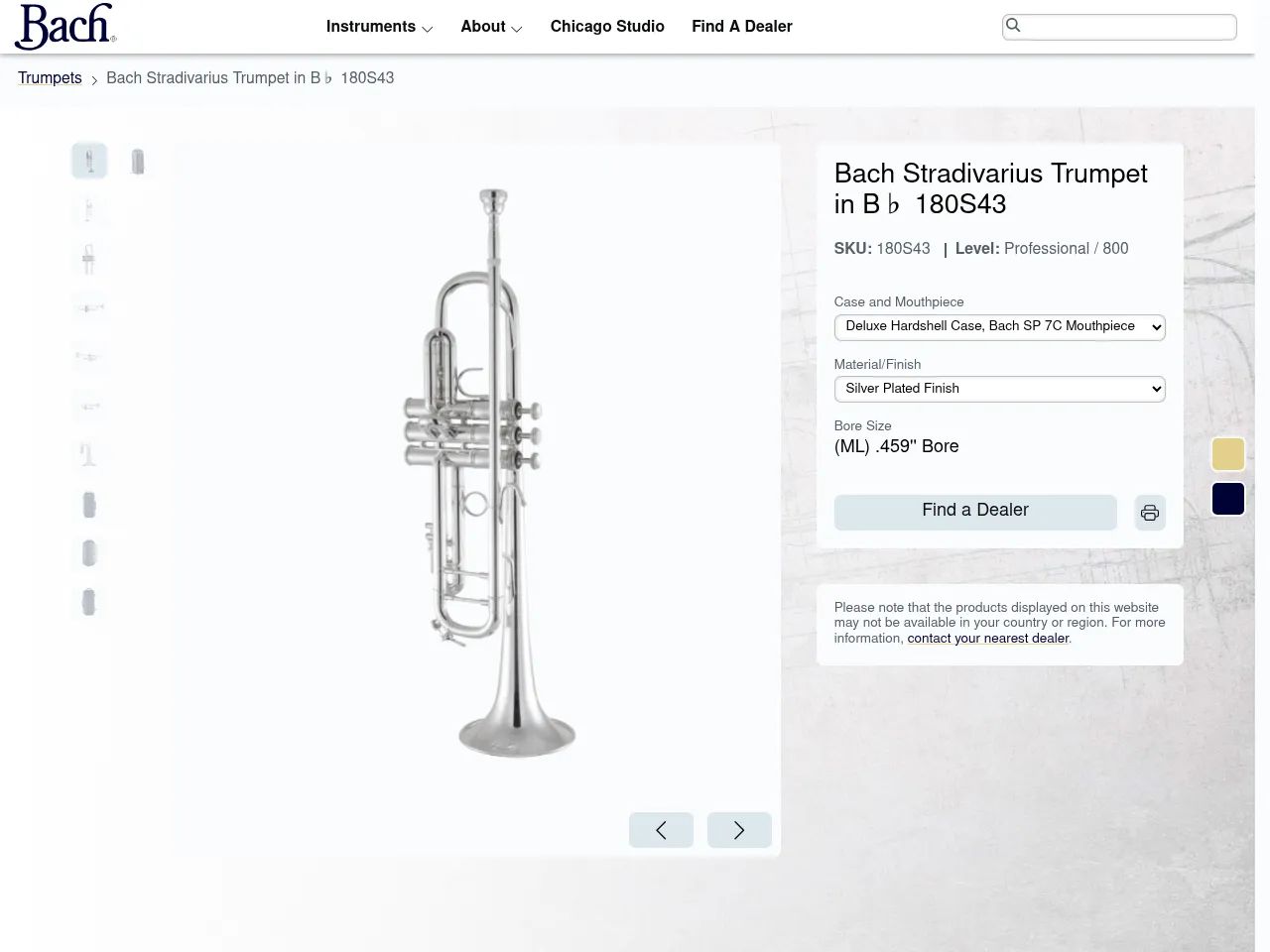
 Bach 180S43 Stradivarius Professional Bb Trumpet
Bach
$3,899
Professional
United States
The Bach 180S43 Stradivarius features a larger number 43 hand-hammered bell producing a broader, warmer sound than the standard 37, with silver plating adding brightness and projection for orchestral and commercial trumpet performance.
Bach 180S43 Stradivarius Professional Bb Trumpet
Bach
$3,899
Professional
United States
The Bach 180S43 Stradivarius features a larger number 43 hand-hammered bell producing a broader, warmer sound than the standard 37, with silver plating adding brightness and projection for orchestral and commercial trumpet performance.
 3
4.8
3
4.8
 Bach Stradivarius 180S37 Professional Bb Trumpet
Bach
$3,799
Professional
USA
The Bach Stradivarius 180S37 is arguably the most iconic professional trumpet in the world, the benchmark against which all others are measured, with its hand-hammered bell delivering rich, warm, complex tone that blends and projects beautifully.
Bach Stradivarius 180S37 Professional Bb Trumpet
Bach
$3,799
Professional
USA
The Bach Stradivarius 180S37 is arguably the most iconic professional trumpet in the world, the benchmark against which all others are measured, with its hand-hammered bell delivering rich, warm, complex tone that blends and projects beautifully.
 4
4.8
4
4.8
 Getzen 3050 Genesis Professional Bb Trumpet
Getzen
$3,299
Professional
USA
A professional Bb trumpet handcrafted in Wisconsin with hand-hammered bell and hand-lapped Monel pistons, delivering a brilliant, projecting sound that excels in big band, jazz, and commercial settings.
Getzen 3050 Genesis Professional Bb Trumpet
Getzen
$3,299
Professional
USA
A professional Bb trumpet handcrafted in Wisconsin with hand-hammered bell and hand-lapped Monel pistons, delivering a brilliant, projecting sound that excels in big band, jazz, and commercial settings.
 5
4.8
5
4.8
 Yamaha YTR-2330 Standard Bb Trumpet
Yamaha
$1,259
Beginner
Japan
Gold-standard student Bb trumpet with Monel pistons and accurate intonation, offering reliable build quality and musical tone that consistently outperforms its price point.
Yamaha YTR-2330 Standard Bb Trumpet
Yamaha
$1,259
Beginner
Japan
Gold-standard student Bb trumpet with Monel pistons and accurate intonation, offering reliable build quality and musical tone that consistently outperforms its price point.
 6
4.8
6
4.8
 Yamaha YTR-8310Z Bobby Shew Jazz Bb Trumpet
Yamaha
$3,399
Professional
Japan
Professional jazz trumpet co-designed with Bobby Shew, offering a dark, flexible tone with intimate dynamic control optimized for small combo and acoustic jazz settings.
Yamaha YTR-8310Z Bobby Shew Jazz Bb Trumpet
Yamaha
$3,399
Professional
Japan
Professional jazz trumpet co-designed with Bobby Shew, offering a dark, flexible tone with intimate dynamic control optimized for small combo and acoustic jazz settings.
 7
4.8
7
4.8
 Yamaha YTR-8335LA Xeno Artist Model Bobby Shew Bb Trumpet
Yamaha
$3,699
Professional
Japan
Xeno Artist Model developed with Bobby Shew for lead trumpet playing, featuring a reversed tuning slide and larger bore for effortless upper-register projection in big band settings.
Yamaha YTR-8335LA Xeno Artist Model Bobby Shew Bb Trumpet
Yamaha
$3,699
Professional
Japan
Xeno Artist Model developed with Bobby Shew for lead trumpet playing, featuring a reversed tuning slide and larger bore for effortless upper-register projection in big band settings.
 8
4.7
8
4.7
 Yamaha YTR-5335GII Intermediate Bb Trumpet
Yamaha
$1,799
Intermediate
Japan
Step-up intermediate trumpet with gold brass bell and durable Monel pistons, delivering warm tone and reliable intonation for serious students preparing for auditions.
Yamaha YTR-5335GII Intermediate Bb Trumpet
Yamaha
$1,799
Intermediate
Japan
Step-up intermediate trumpet with gold brass bell and durable Monel pistons, delivering warm tone and reliable intonation for serious students preparing for auditions.
 9
4.7
9
4.7
 Yamaha YTR-6335 Professional Bb Trumpet
Yamaha
$3,099
Professional
Japan
Professional Bb trumpet with extraordinary manufacturing consistency and precise intonation, favored by studio and section players who demand rock-solid pitch reliability.
Yamaha YTR-6335 Professional Bb Trumpet
Yamaha
$3,099
Professional
Japan
Professional Bb trumpet with extraordinary manufacturing consistency and precise intonation, favored by studio and section players who demand rock-solid pitch reliability.
 10
4.6
10
4.6
 Jean Paul USA TR-430 Intermediate Bb Trumpet
Jean Paul USA
$459
Intermediate
China
An intermediate Bb trumpet with rose brass bell and Monel pistons delivering warm tone and smooth valve action at a price well below legacy brands, with a comprehensive case and accessories package.
Jean Paul USA TR-430 Intermediate Bb Trumpet
Jean Paul USA
$459
Intermediate
China
An intermediate Bb trumpet with rose brass bell and Monel pistons delivering warm tone and smooth valve action at a price well below legacy brands, with a comprehensive case and accessories package.
 11
4.6
11
4.6
 Yamaha YTR-4335GII Intermediate Bb Trumpet
Yamaha
$2,149
Intermediate
Japan
Intermediate trumpet with a warm gold brass bell and smooth Monel valves, bridging the gap between student and professional with improved tonal depth and character.
Yamaha YTR-4335GII Intermediate Bb Trumpet
Yamaha
$2,149
Intermediate
Japan
Intermediate trumpet with a warm gold brass bell and smooth Monel valves, bridging the gap between student and professional with improved tonal depth and character.
 12
4.6
Conn 52BSP CONNstellation Professional Bb Trumpet
Conn
$4,199
Professional
USA
The Conn 52BSP CONNstellation features a hand-hammered sterling silver bell producing a darker, richer tone than yellow brass, with velvety warmth that classical and lyrical trumpet players find irresistible for orchestral and solo work.
12
4.6
Conn 52BSP CONNstellation Professional Bb Trumpet
Conn
$4,199
Professional
USA
The Conn 52BSP CONNstellation features a hand-hammered sterling silver bell producing a darker, richer tone than yellow brass, with velvety warmth that classical and lyrical trumpet players find irresistible for orchestral and solo work.
 13
4.4
13
4.4
 Jupiter JTR700 Standard Bb Trumpet
Jupiter
$899
Beginner
Taiwan
A dependable student trumpet with rose brass leadpipe and stainless steel pistons, offering reliable performance and solid build quality for beginning band programs at an accessible price.
Jupiter JTR700 Standard Bb Trumpet
Jupiter
$899
Beginner
Taiwan
A dependable student trumpet with rose brass leadpipe and stainless steel pistons, offering reliable performance and solid build quality for beginning band programs at an accessible price.
 14
4.2
14
4.2
 Bach TR300H2 Student Bb Trumpet
Bach
$1,399
Beginner
USA
The Bach TR300H2 carries the Bach name into the student market with Monel alloy pistons offering smoother valve action than competitors and a warm, centered tone that gives young players a head start on developing quality sound.
Bach TR300H2 Student Bb Trumpet
Bach
$1,399
Beginner
USA
The Bach TR300H2 carries the Bach name into the student market with Monel alloy pistons offering smoother valve action than competitors and a warm, centered tone that gives young players a head start on developing quality sound.