Violas - Directory w/ AI Reviews
Acoustic violas for orchestral and chamber music
The viola is a bowed string instrument slightly larger than the violin, producing a warmer, deeper, and more mellow tone. It plays a crucial harmonic role in orchestras and string quartets, bridging the gap between the violin's brightness and the cello's depth. Though often overlooked in favor of the violin, the viola has a distinctive, hauntingly beautiful voice.
History
The viola emerged alongside the violin in 16th-century Italy, crafted by the same Cremonese makers including Andrea Amati and Gasparo da Salo. For centuries, it was considered a secondary instrument, often assigned to less skilled players in orchestras. The 20th century saw a viola renaissance, with players like William Primrose and Lionel Tertis establishing it as a serious solo instrument.
Characteristics
The viola is tuned in fifths (C-G-D-A), a fifth below the violin, and reads music in the alto clef, unique among orchestral string instruments. Its larger body (15.5 to 17 inches compared to the violin's 14 inches) produces warmer, darker overtones. The slightly thicker strings and longer scale length require more finger pressure and a wider hand stretch than the violin.
Notable Players
William Primrose was the first violist to establish the instrument as a respected solo voice in the 20th century. Kim Kashkashian is a contemporary viola virtuoso and Grammy-winning recording artist. Tabea Zimmermann is widely regarded as one of the foremost viola soloists performing today, known for her rich tone and profound musicality.
Fun Facts
The viola has been the subject of more musician jokes than any other instrument, despite being essential to every orchestra and string quartet. Mozart, Beethoven, and Dvorak all played the viola in string quartets, preferring its inner voice to the more prominent violin.
 1
4.7
1
4.7
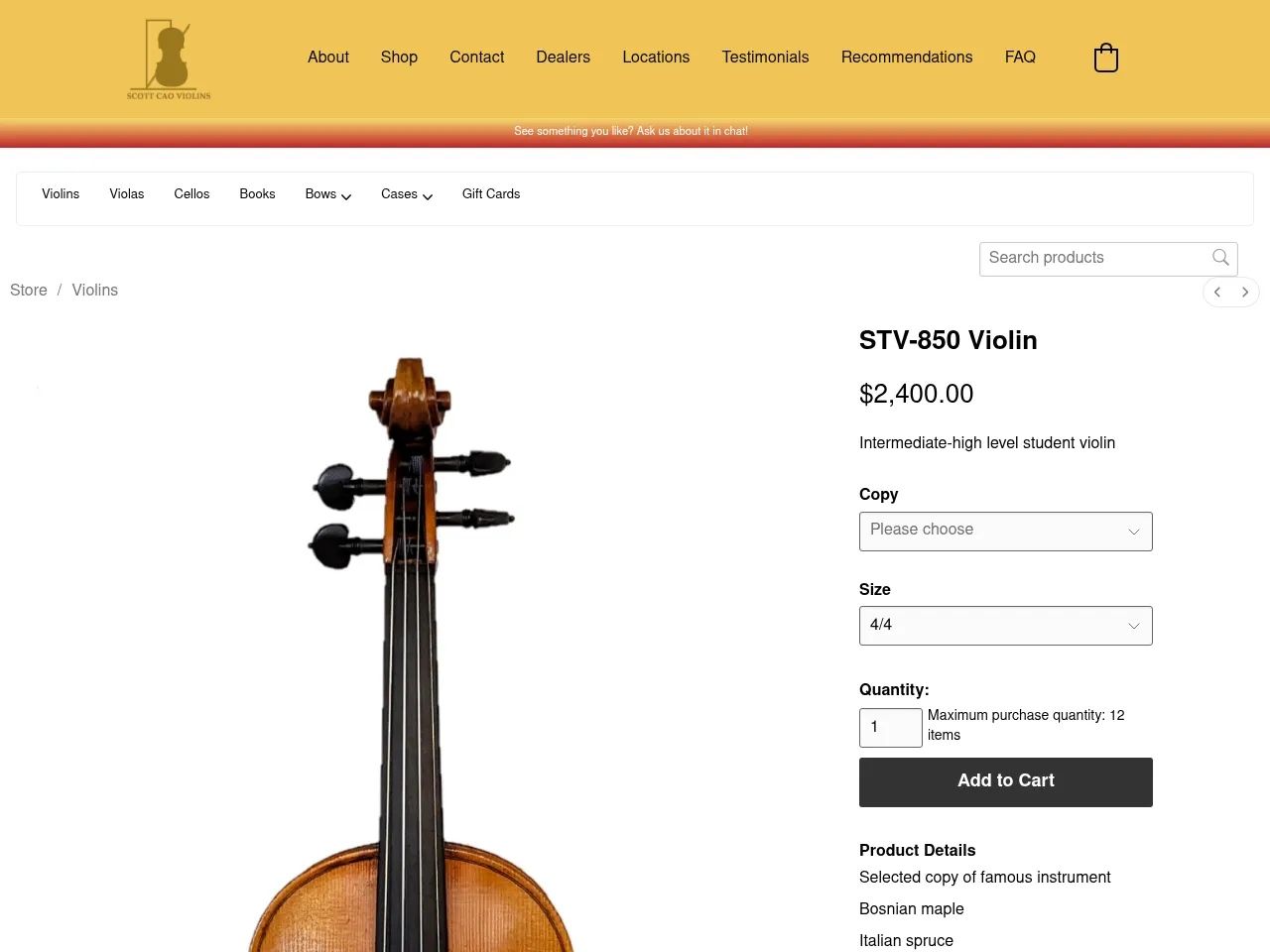
 Scott Cao STV-850 Viola
Scott Cao
$4,500
Professional
China
Professional viola with aged European spruce and premium flamed maple delivering deep, sonorous tone with exceptional carrying power for conservatory and orchestral players.
Scott Cao STV-850 Viola
Scott Cao
$4,500
Professional
China
Professional viola with aged European spruce and premium flamed maple delivering deep, sonorous tone with exceptional carrying power for conservatory and orchestral players.
 2
4.6
2
4.6
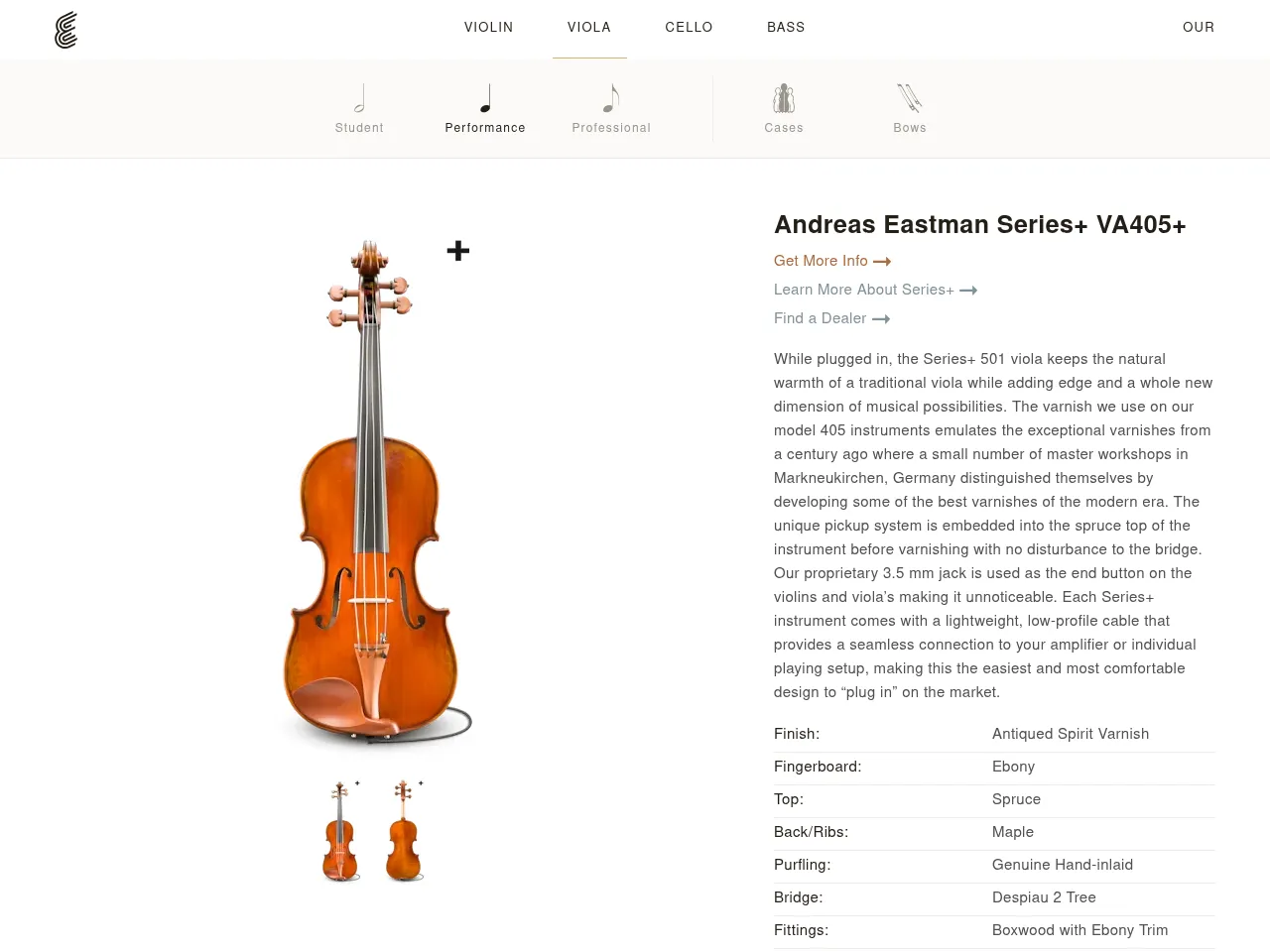
 Eastman VA405 Viola
Eastman
$1,799
Intermediate
China
The Eastman VA405 is a step-up viola with hand-carved spruce and flamed maple producing warm, singing tone with characteristic viola darkness, arriving with a solid factory setup and attractive antique varnish.
Eastman VA405 Viola
Eastman
$1,799
Intermediate
China
The Eastman VA405 is a step-up viola with hand-carved spruce and flamed maple producing warm, singing tone with characteristic viola darkness, arriving with a solid factory setup and attractive antique varnish.
 3
4.6
3
4.6
 Yamaha AVA7 Braviol Viola
Yamaha
$4,999
Professional
Japan
Professional-grade viola combining Yamaha's acoustical research with hand craftsmanship, producing a rich, powerful tone with excellent dynamic range for orchestral and chamber settings.
Yamaha AVA7 Braviol Viola
Yamaha
$4,999
Professional
Japan
Professional-grade viola combining Yamaha's acoustical research with hand craftsmanship, producing a rich, powerful tone with excellent dynamic range for orchestral and chamber settings.
 4
4.6
4
4.6
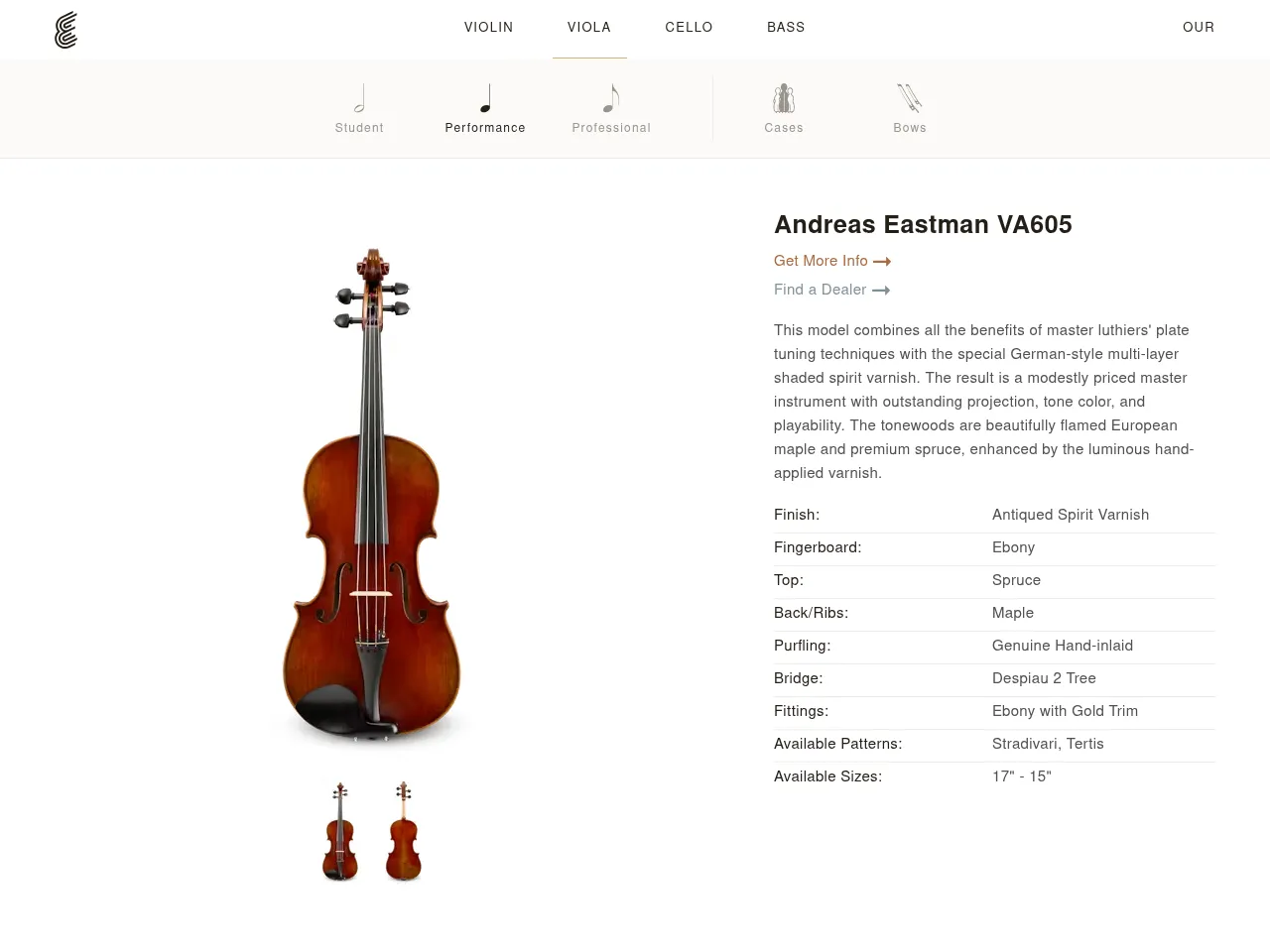
 Eastman VA605 Viola
Eastman
$4,680
Advanced
China
The Eastman VA605 is a performance-grade viola for advanced students and professionals, with select aged spruce and deeply flamed maple delivering powerful, complex sound with extraordinary projection for recital and orchestral use.
Eastman VA605 Viola
Eastman
$4,680
Advanced
China
The Eastman VA605 is a performance-grade viola for advanced students and professionals, with select aged spruce and deeply flamed maple delivering powerful, complex sound with extraordinary projection for recital and orchestral use.
 5
4.4
5
4.4
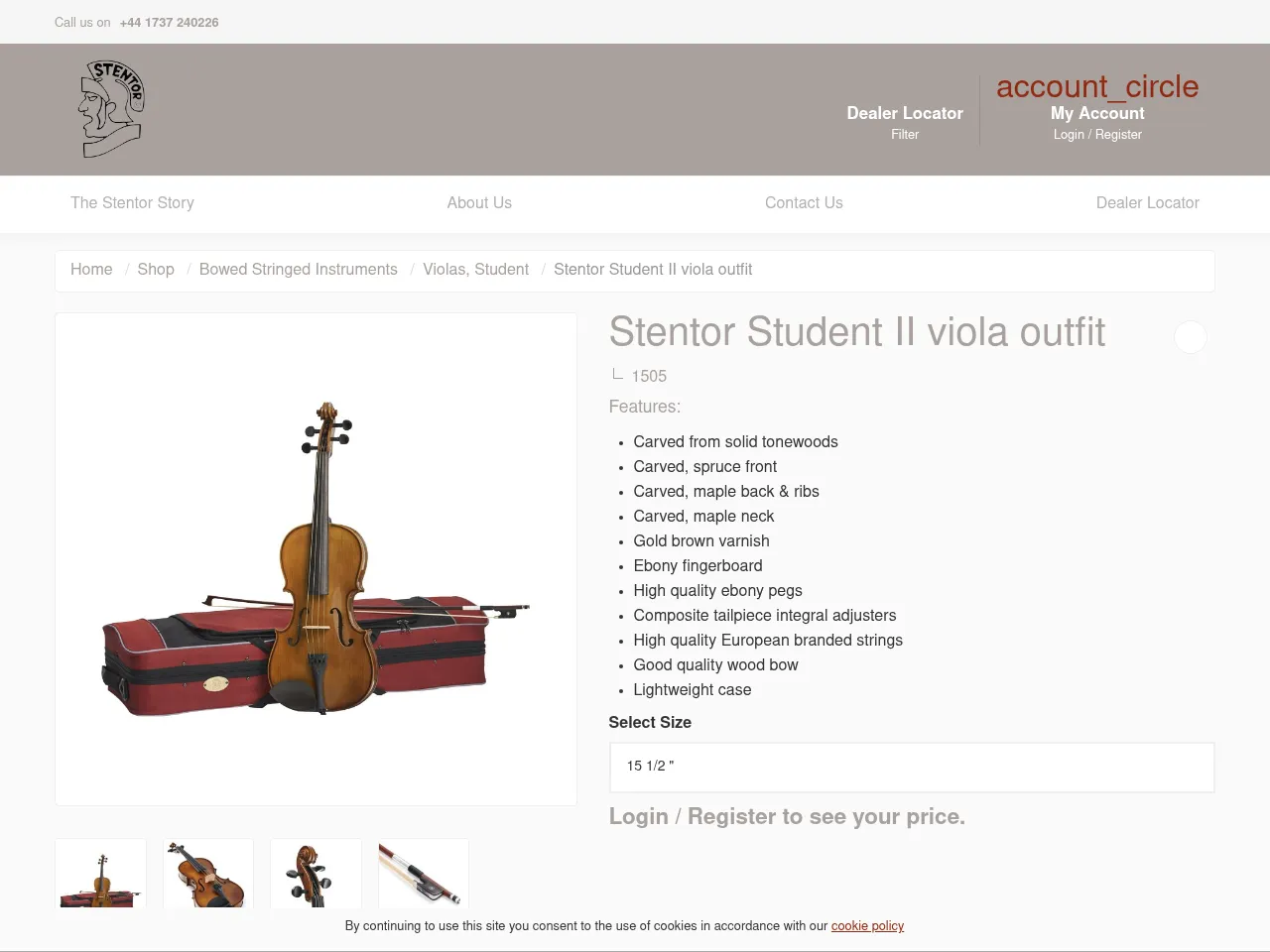
 Stentor Student II Viola
Stentor
$449
Beginner
China
Well-regarded entry-level viola with solid spruce and maple construction trusted by string teachers worldwide for consistent build quality and genuine musical character.
Stentor Student II Viola
Stentor
$449
Beginner
China
Well-regarded entry-level viola with solid spruce and maple construction trusted by string teachers worldwide for consistent build quality and genuine musical character.
 6
4.4
6
4.4
 Yamaha AVA5 Viola
Yamaha
$1,199
Beginner
China
Reliable student viola with solid spruce top and maple back, offering consistent Yamaha factory setup and balanced tone across multiple sizes for growing students.
Yamaha AVA5 Viola
Yamaha
$1,199
Beginner
China
Reliable student viola with solid spruce top and maple back, offering consistent Yamaha factory setup and balanced tone across multiple sizes for growing students.
 7
4.4
7
4.4
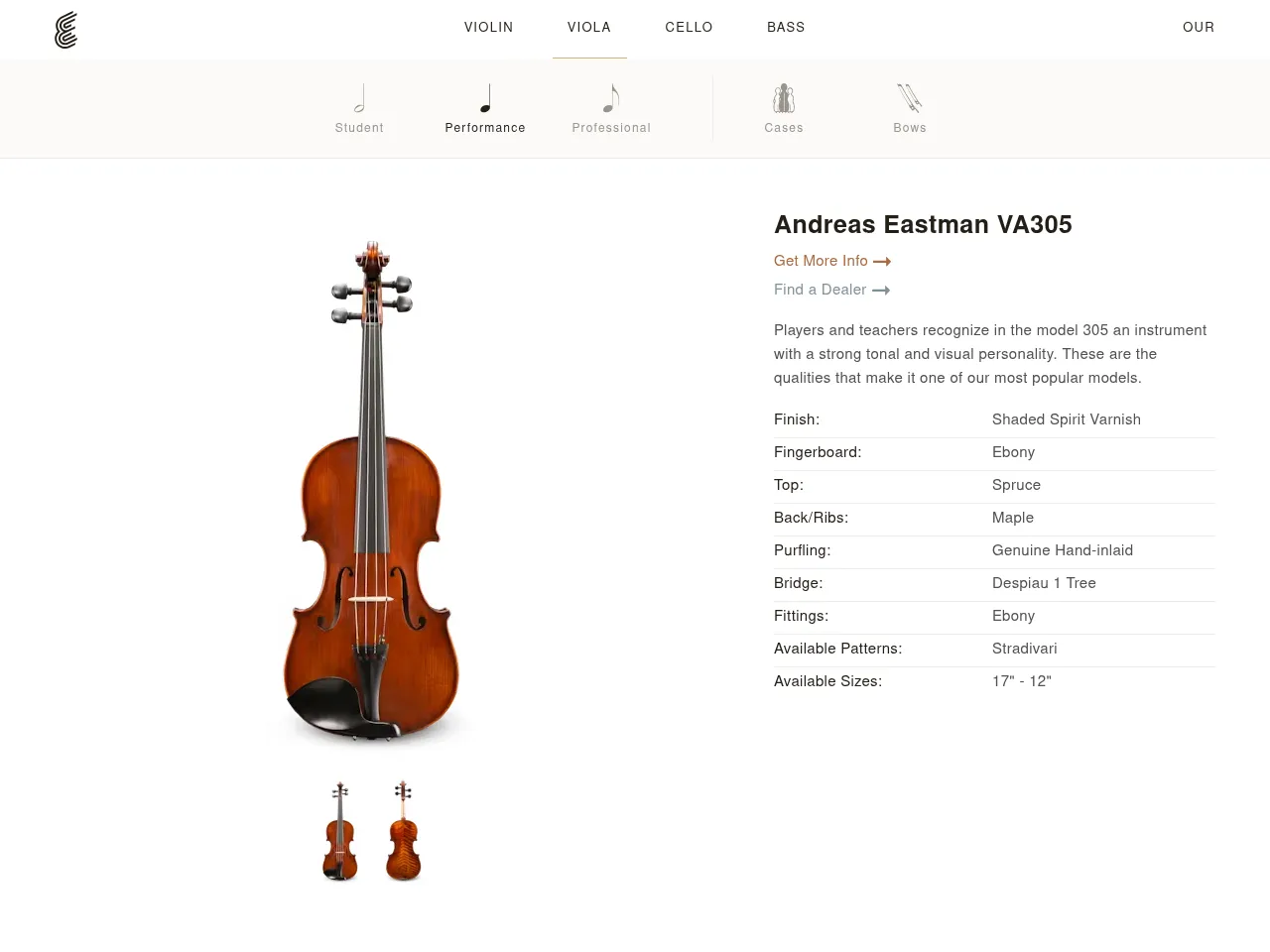
 Eastman VA305 Viola
Eastman
$1,920
Intermediate
China
The Eastman VA305 is a step-up viola with hand-applied spirit varnish and traditional construction delivering exceptional tonal warmth, a favorite among students advancing into youth orchestra and serious study.
Eastman VA305 Viola
Eastman
$1,920
Intermediate
China
The Eastman VA305 is a step-up viola with hand-applied spirit varnish and traditional construction delivering exceptional tonal warmth, a favorite among students advancing into youth orchestra and serious study.
 8
4.3
8
4.3
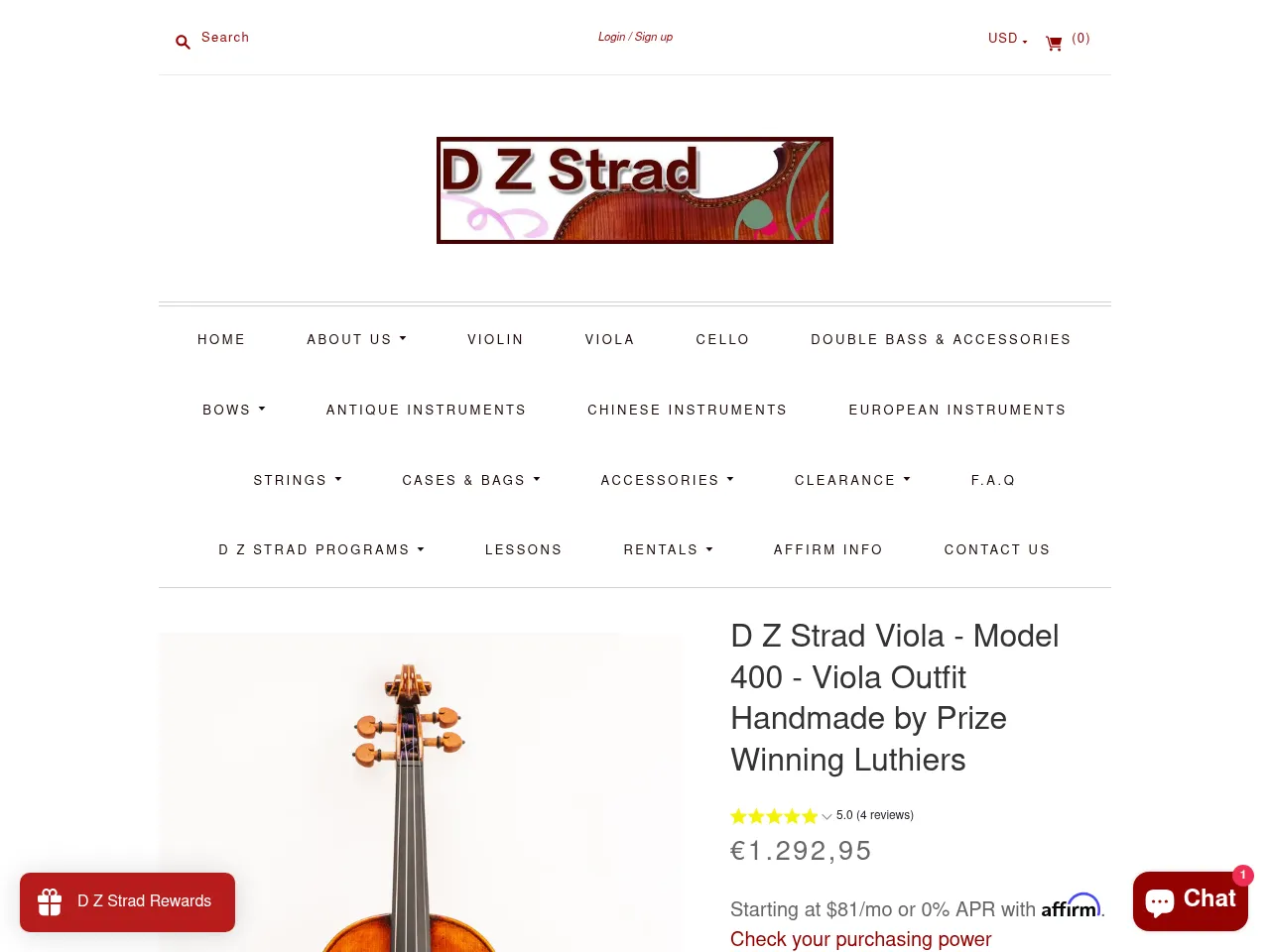
 DZ Strad Model 400 Viola
DZ Strad
$1,800
Intermediate
China
A handmade viola with solid spruce top and flamed maple back finished in antiqued oil varnish, offering a characteristically dark, full tone with excellent depth that suits intermediate students and advancing amateurs.
DZ Strad Model 400 Viola
DZ Strad
$1,800
Intermediate
China
A handmade viola with solid spruce top and flamed maple back finished in antiqued oil varnish, offering a characteristically dark, full tone with excellent depth that suits intermediate students and advancing amateurs.
 9
4.2
9
4.2
 Cremona SVA-175 Premier Student Viola
Cremona
$449
Beginner
China
The Cremona SVA-175 is a well-regarded student viola with a hand-carved spruce top and maple body producing warm, even tone, available in sizes from 12 to 16 inches with Prelude strings and ebony fittings for developing students.
Cremona SVA-175 Premier Student Viola
Cremona
$449
Beginner
China
The Cremona SVA-175 is a well-regarded student viola with a hand-carved spruce top and maple body producing warm, even tone, available in sizes from 12 to 16 inches with Prelude strings and ebony fittings for developing students.
 10
4.1
10
4.1
 Cremona SVA-500 Viola
Cremona
$1,100
Intermediate
China
The Cremona SVA-500 is a step-up viola with highly flamed maple and hand-applied oil varnish, offering full, resonant tone with dark character on the lower strings and sweet clarity on the A string for advancing students.
Cremona SVA-500 Viola
Cremona
$1,100
Intermediate
China
The Cremona SVA-500 is a step-up viola with highly flamed maple and hand-applied oil varnish, offering full, resonant tone with dark character on the lower strings and sweet clarity on the A string for advancing students.