Banjos - Directory w/ AI Reviews
4-string, 5-string, and 6-string banjos for bluegrass and folk
The banjo is a stringed instrument with a thin membrane (head) stretched over a circular frame, producing a bright, percussive, and distinctly twangy tone. It is most commonly associated with bluegrass, country, folk, and Dixieland jazz. Banjos come in four-, five-, and six-string configurations, each suited to different musical styles.
History
The banjo has African origins, descending from gourd-bodied, skin-headed instruments brought to the Americas by enslaved Africans. Joel Sweeney is often credited with adding a fifth drone string in the 1830s, though this is debated. Earl Scruggs revolutionized the instrument in the 1940s with his three-finger picking style, which became the defining technique of bluegrass banjo.
Characteristics
The five-string banjo, the most common type, features four main strings plus a shorter fifth string that acts as a high drone. Its distinctive sound comes from the drum-like head (traditionally animal skin, now typically Mylar), which produces a bright, projecting tone with rapid decay. Playing styles include Scruggs-style three-finger picking (bluegrass), clawhammer/frailing (old-time), and single-string/melodic approaches.
Notable Players
Earl Scruggs's three-finger picking technique revolutionized the five-string banjo and became the foundation of bluegrass music. Bela Fleck has pushed the banjo into jazz, classical, and world music territories, earning Grammy Awards in more categories than any other instrumentalist. Steve Martin, the comedian and actor, is also a Grammy-winning banjo player who has helped bring the instrument to mainstream attention.
Fun Facts
The banjo is actually louder than a guitar in acoustic settings, which is why it became the lead instrument in early string bands before amplification. Steve Martin has said that the banjo is "the most un-sad instrument in the world" because it's nearly impossible to play a sad-sounding banjo song.
 1
4.7
1
4.7
 Gold Tone OB-250+ Orange Blossom Banjo
Gold Tone
$2,799
Advanced
United States
A professional-caliber banjo with cast bronze tone ring and bound ebony fingerboard delivering bell-like tone with sparkling highs, competing with instruments costing significantly more in the bluegrass market.
Gold Tone OB-250+ Orange Blossom Banjo
Gold Tone
$2,799
Advanced
United States
A professional-caliber banjo with cast bronze tone ring and bound ebony fingerboard delivering bell-like tone with sparkling highs, competing with instruments costing significantly more in the bluegrass market.
 2
4.7
2
4.7
 Recording King R-35-BR Madison Banjo
Recording King
$699
Intermediate
China
Mid-priced five-string resonator banjo with maple rim, brass tone ring, and one-piece flange delivering warm, authoritative tone above its price class.
Recording King R-35-BR Madison Banjo
Recording King
$699
Intermediate
China
Mid-priced five-string resonator banjo with maple rim, brass tone ring, and one-piece flange delivering warm, authoritative tone above its price class.
 3
4.7
3
4.7
 Deering Eagle II 5-String Banjo
Deering
$3,999
Professional
United States
A flagship American-made banjo featuring a bell bronze tone ring and ebony fingerboard that delivers an authoritative, cutting tone with brilliant highs and impressive sustain for professional bluegrass performance.
Deering Eagle II 5-String Banjo
Deering
$3,999
Professional
United States
A flagship American-made banjo featuring a bell bronze tone ring and ebony fingerboard that delivers an authoritative, cutting tone with brilliant highs and impressive sustain for professional bluegrass performance.
 4
4.6
4
4.6
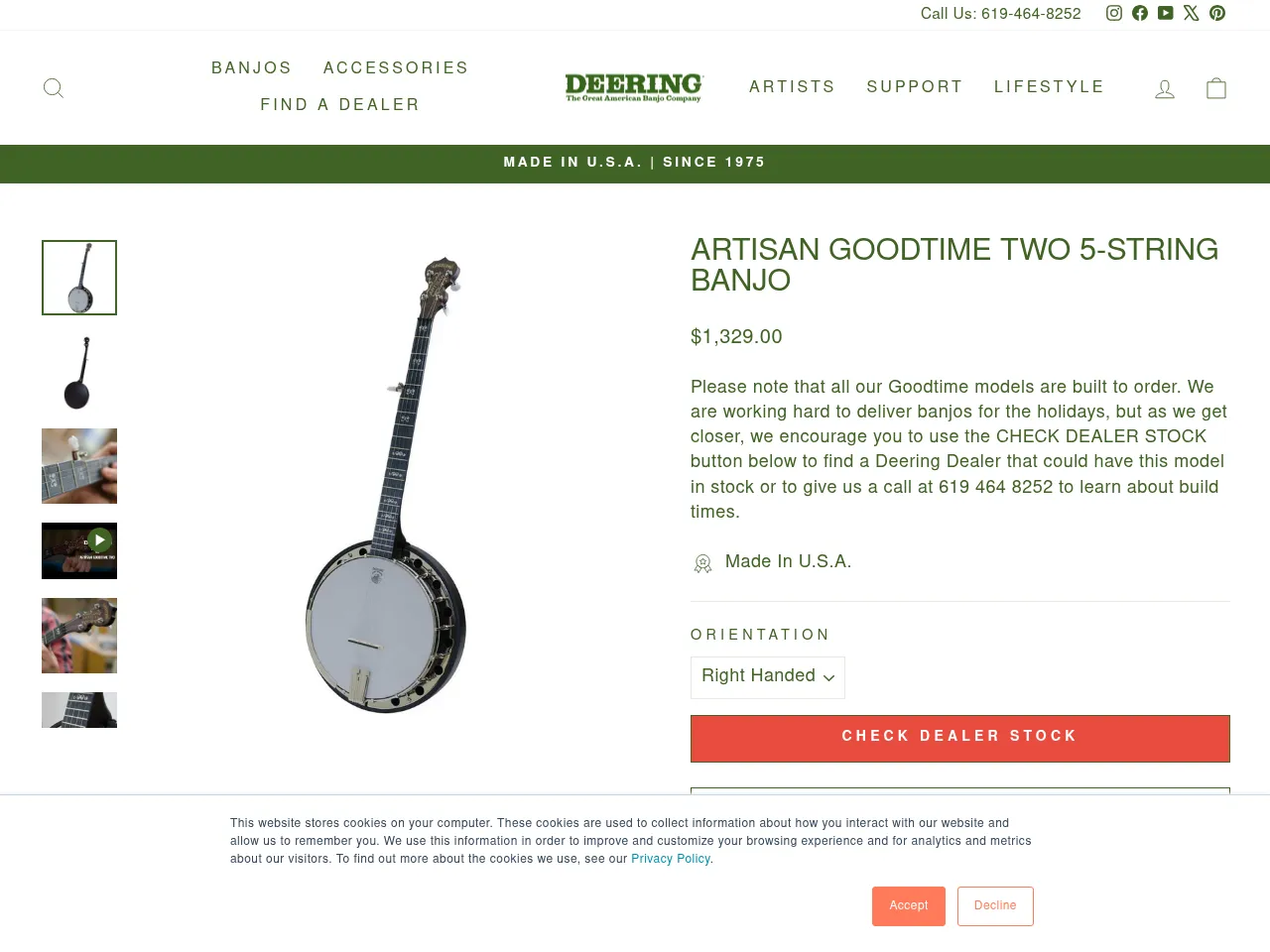
 Deering Artisan Goodtime Two 5-String Banjo
Deering
$899
Intermediate
United States
An enhanced Goodtime Two with a scooped fingerboard and slimmer neck profile that dramatically improves playing comfort, built in the USA from three-ply maple with a resonator back for bright bluegrass projection.
Deering Artisan Goodtime Two 5-String Banjo
Deering
$899
Intermediate
United States
An enhanced Goodtime Two with a scooped fingerboard and slimmer neck profile that dramatically improves playing comfort, built in the USA from three-ply maple with a resonator back for bright bluegrass projection.
 5
4.6
5
4.6
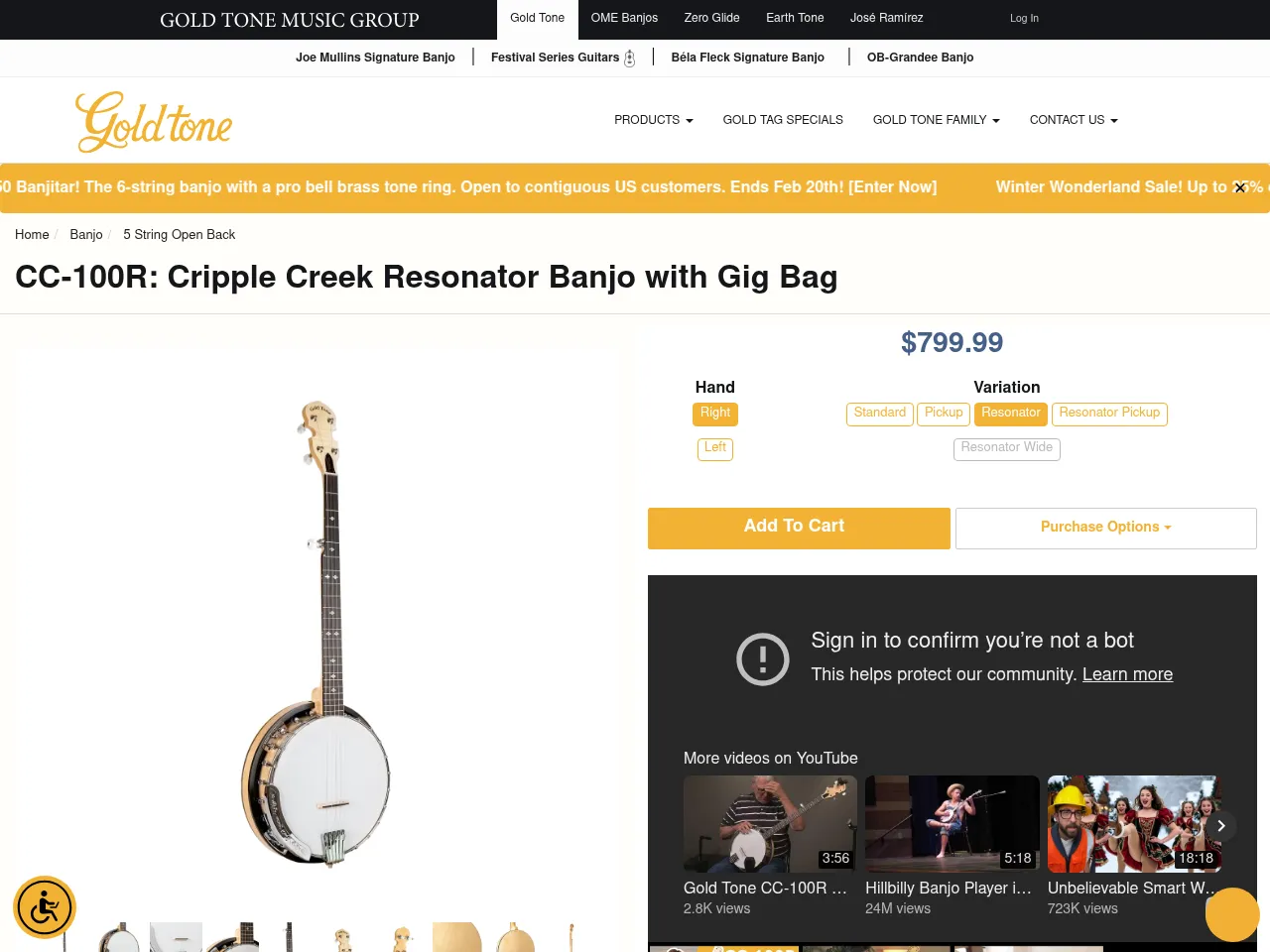
 Gold Tone CC-100R Cripple Creek Banjo
Gold Tone
$449
Beginner
China
One of the most popular entry-level resonator banjos with bright, focused tone from a multi-ply maple rim, delivering competent bluegrass sound at a price that does not intimidate newcomers.
Gold Tone CC-100R Cripple Creek Banjo
Gold Tone
$449
Beginner
China
One of the most popular entry-level resonator banjos with bright, focused tone from a multi-ply maple rim, delivering competent bluegrass sound at a price that does not intimidate newcomers.
 6
4.6
6
4.6
 Deering Sierra 5-String Banjo
Deering
$2,299
Intermediate
United States
A professional-grade banjo with a bell bronze tone ring that sits in the sweet spot between Deering's entry and flagship lines, offering a rich, full-bodied tone suited for intermediate to advanced bluegrass and folk players.
Deering Sierra 5-String Banjo
Deering
$2,299
Intermediate
United States
A professional-grade banjo with a bell bronze tone ring that sits in the sweet spot between Deering's entry and flagship lines, offering a rich, full-bodied tone suited for intermediate to advanced bluegrass and folk players.
 7
4.5
7
4.5
 Gold Tone BG-250F Plus Bluegrass Banjo
Gold Tone
$849
Intermediate
China
A mid-range resonator banjo with maple rim and cast aluminum tone ring featuring an included pickup system, making it one of the more gig-ready banjos at its price for both acoustic jams and amplified stages.
Gold Tone BG-250F Plus Bluegrass Banjo
Gold Tone
$849
Intermediate
China
A mid-range resonator banjo with maple rim and cast aluminum tone ring featuring an included pickup system, making it one of the more gig-ready banjos at its price for both acoustic jams and amplified stages.
 8
4.4
8
4.4
 Deering Goodtime Two 5-String Banjo
Deering
$799
Beginner
United States
One of the strongest values in American-made banjos, combining a three-ply maple rim and resonator with reliable build quality to deliver the bright, punchy tone needed for bluegrass at an approachable price.
Deering Goodtime Two 5-String Banjo
Deering
$799
Beginner
United States
One of the strongest values in American-made banjos, combining a three-ply maple rim and resonator with reliable build quality to deliver the bright, punchy tone needed for bluegrass at an approachable price.
 9
4.2
9
4.2
 Epiphone MB-200 Banjo
Epiphone
$299
Beginner
China
A budget-friendly five-string resonator banjo with mahogany rim producing warmer, mellower tones suited for old-time and folk styles, ideal for beginners testing the waters before a larger investment.
Epiphone MB-200 Banjo
Epiphone
$299
Beginner
China
A budget-friendly five-string resonator banjo with mahogany rim producing warmer, mellower tones suited for old-time and folk styles, ideal for beginners testing the waters before a larger investment.
 10
4.2
10
4.2
 Ibanez B200 5-String Banjo
Ibanez
$399
Beginner
China
A value-oriented five-string banjo with maple rim and comfortable neck profile that feels familiar to guitarists, featuring quality hardware and die-cast tuners that outperform many competitors at the price.
Ibanez B200 5-String Banjo
Ibanez
$399
Beginner
China
A value-oriented five-string banjo with maple rim and comfortable neck profile that feels familiar to guitarists, featuring quality hardware and die-cast tuners that outperform many competitors at the price.