French Horns - Directory w/ AI Reviews
Single, double, and triple french horns
The French horn is a coiled brass instrument with a wide, flaring bell, known for its warm, mellow, and noble tone. It has the widest usable range of any brass instrument, spanning over four octaves. The French horn is a staple of orchestras and wind ensembles, and its sound is iconic in film scores and fanfares.
History
The horn descended from hunting horns used in Europe since the Middle Ages, gradually adding hand-stopping techniques and then valves in the early 19th century. Heinrich Stoelzel and Friedrich Bluhmel's invention of the rotary valve around 1818 enabled fully chromatic playing. The double horn, combining Bb and F tubing in one instrument, was developed by Fritz Kruspe in 1897 and became the professional standard.
Characteristics
The French horn uses rotary valves (unlike the piston valves of trumpets) and has over 12 feet of coiled tubing. Players produce different notes by adjusting lip tension (embouchure) through a small, deep, conical mouthpiece. The right hand is placed inside the bell to support the instrument and can be used for hand-stopping, a technique that mutes and alters the pitch.
Notable Players
Dennis Brain is considered the greatest French horn player of the 20th century, whose recordings remain the benchmark for the instrument. Barry Tuckwell had a distinguished solo and orchestral career spanning decades and recorded the complete Mozart horn concerti. Hermann Baumann pioneered the use of the natural (valveless) horn in historically informed performance.
Fun Facts
The French horn is widely considered the hardest brass instrument to play because of its narrow harmonic series, where many notes are extremely close together, making accuracy challenging. If uncoiled, a double French horn's tubing would stretch approximately 22 feet (6.7 meters).
 1
4.9
1
4.9
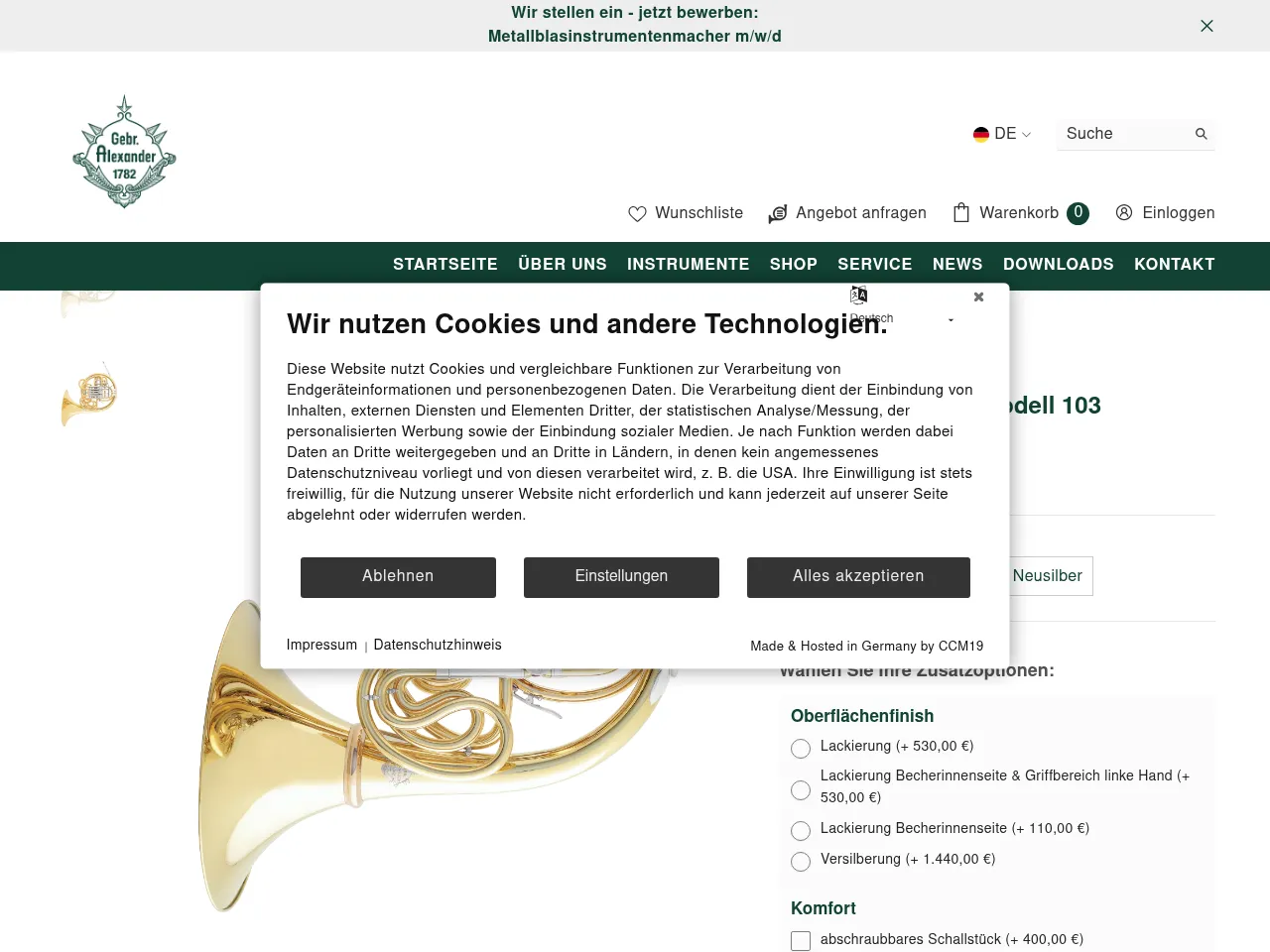
 Alexander 103 Professional Double French Horn
Alexander
$9,499
Professional
Germany
The Alexander 103 is one of the most iconic professional double French horns ever made, handcrafted in Mainz, Germany, with a characteristically warm, dark Germanic tone and hand-lapped rotary valves that have graced principal chairs in leading orchestras.
Alexander 103 Professional Double French Horn
Alexander
$9,499
Professional
Germany
The Alexander 103 is one of the most iconic professional double French horns ever made, handcrafted in Mainz, Germany, with a characteristically warm, dark Germanic tone and hand-lapped rotary valves that have graced principal chairs in leading orchestras.
 2
4.8
2
4.8
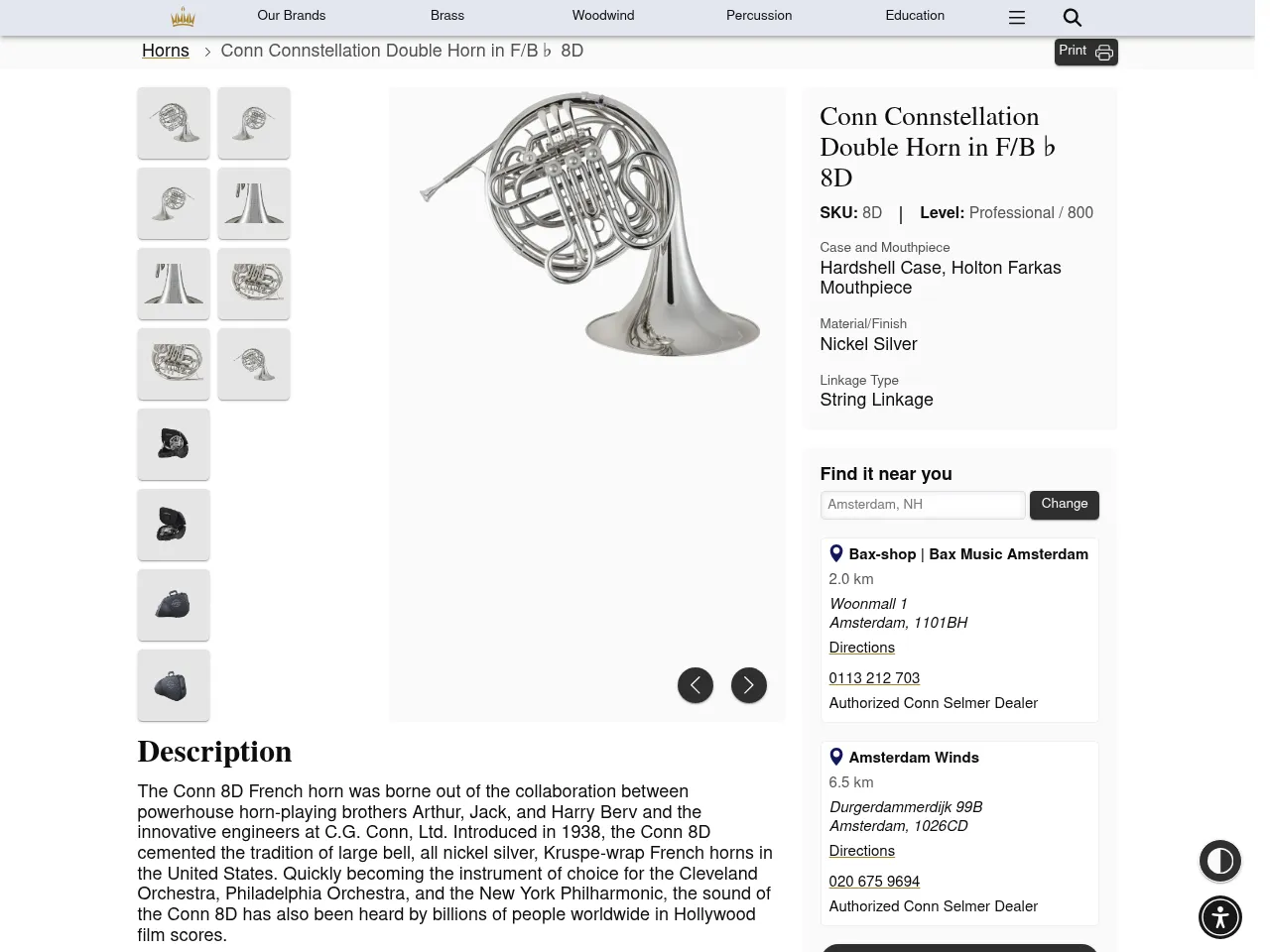
 Conn 8D CONNstellation Professional Double French Horn
Conn
$7,499
Professional
USA
The Conn 8D is the most legendary French horn ever produced, defining the American horn sound for nearly a century with warm, dark nickel silver tone, Kruspe wrap, and string-action linkage standard in American orchestras.
Conn 8D CONNstellation Professional Double French Horn
Conn
$7,499
Professional
USA
The Conn 8D is the most legendary French horn ever produced, defining the American horn sound for nearly a century with warm, dark nickel silver tone, Kruspe wrap, and string-action linkage standard in American orchestras.
 3
4.8
3
4.8
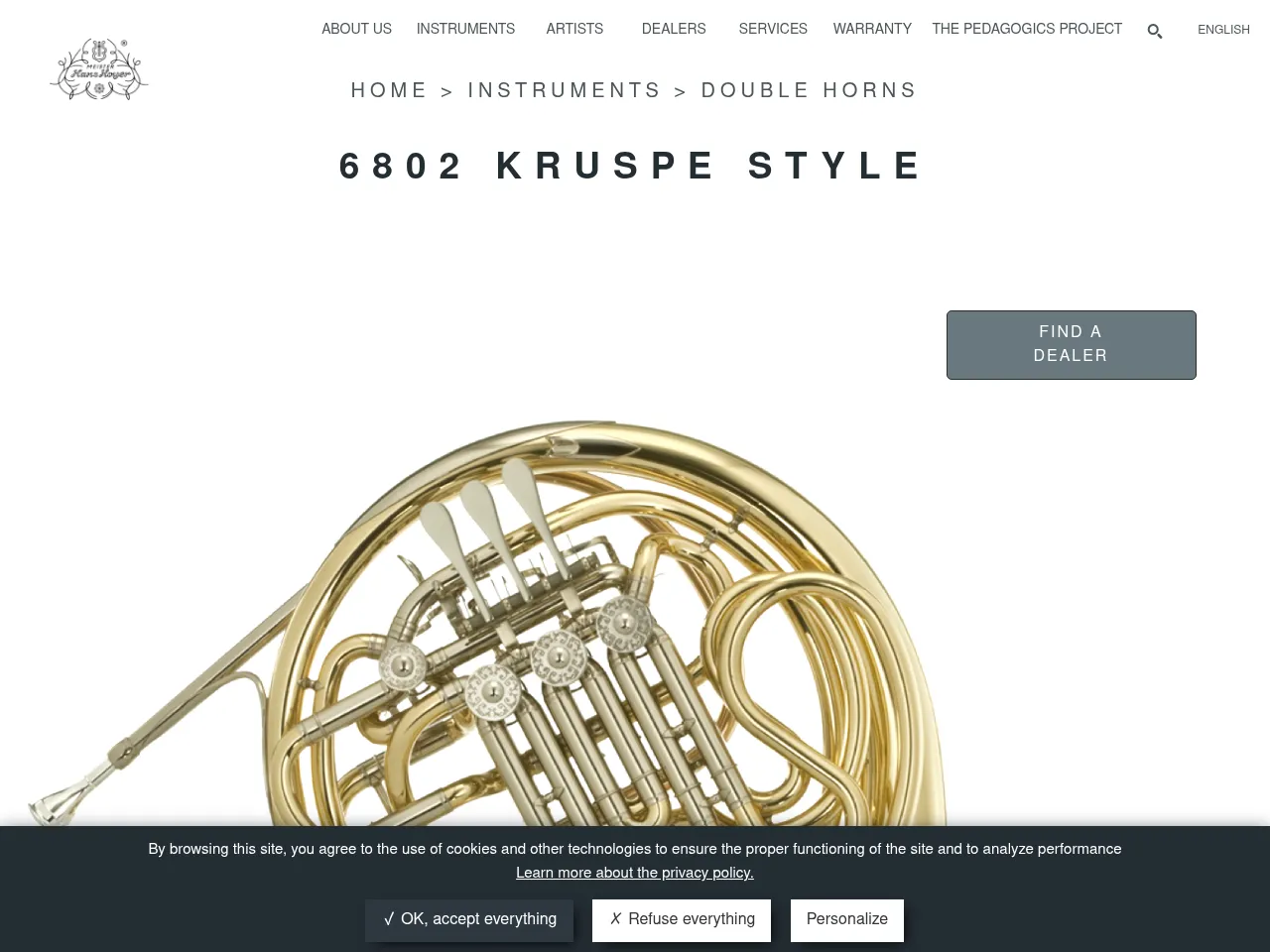
 Hans Hoyer 6802GA Professional Double French Horn
Hans Hoyer
$6,799
Professional
Germany
A professional Geyer-wrap double horn with gold brass bell producing a warm, flexible, projecting sound that balances European and American horn traditions, with fast mechanical-linkage rotary valves.
Hans Hoyer 6802GA Professional Double French Horn
Hans Hoyer
$6,799
Professional
Germany
A professional Geyer-wrap double horn with gold brass bell producing a warm, flexible, projecting sound that balances European and American horn traditions, with fast mechanical-linkage rotary valves.
 4
4.7
4
4.7
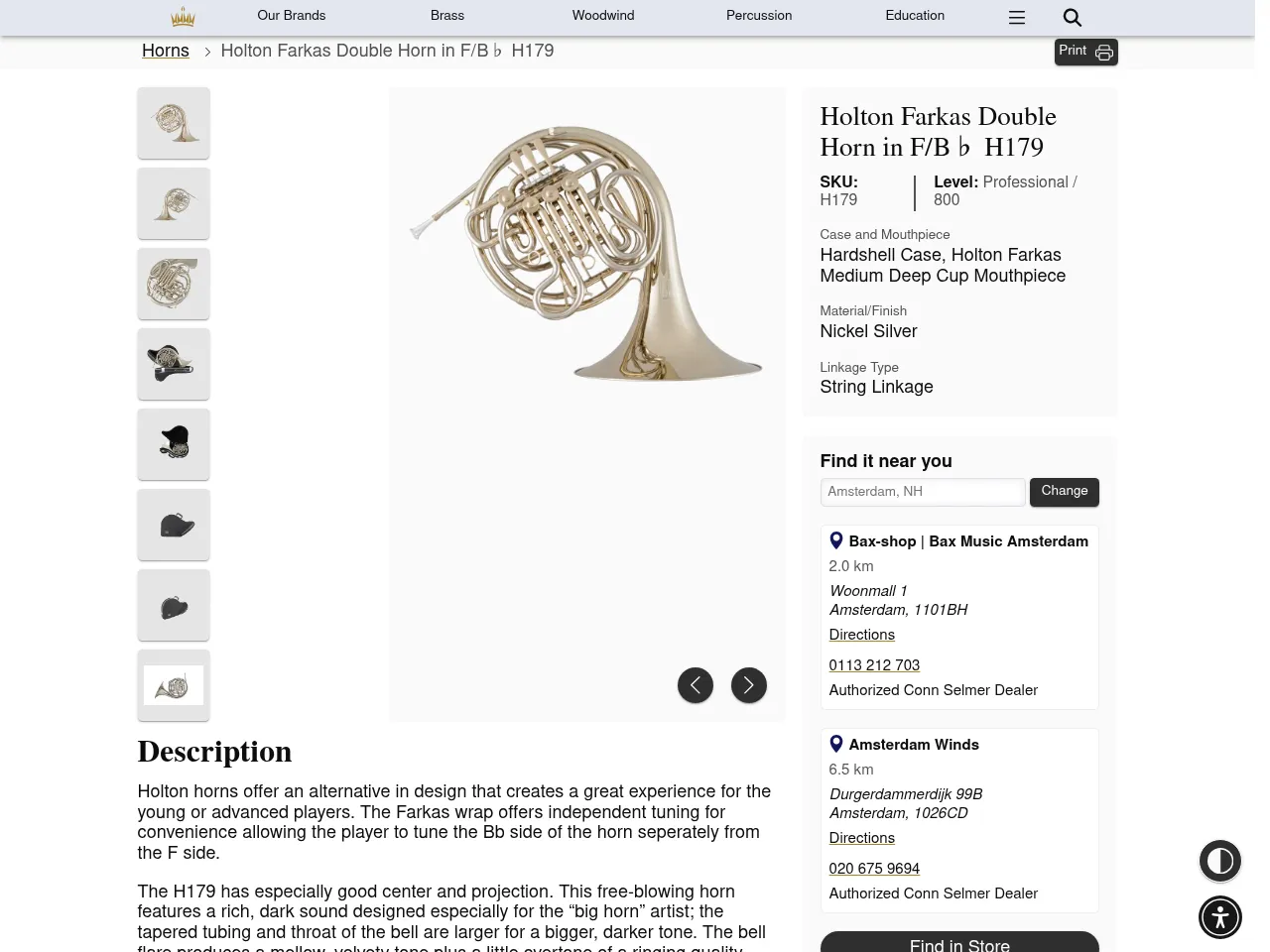
 Holton H179 Farkas Professional Double French Horn
Holton
$5,499
Professional
USA
A professional double horn designed by legendary Chicago Symphony principal Philip Farkas, with nickel silver body and Kruspe wrap delivering warm, round tone with excellent blending qualities.
Holton H179 Farkas Professional Double French Horn
Holton
$5,499
Professional
USA
A professional double horn designed by legendary Chicago Symphony principal Philip Farkas, with nickel silver body and Kruspe wrap delivering warm, round tone with excellent blending qualities.
 5
4.7
5
4.7
 Yamaha YHR-668II Professional Double French Horn
Yamaha
$5,999
Professional
Japan
Professional Geyer-wrap double horn with nickel silver body and string-action rotary valves, delivering bright, focused tone with exceptional consistency for orchestral performance.
Yamaha YHR-668II Professional Double French Horn
Yamaha
$5,999
Professional
Japan
Professional Geyer-wrap double horn with nickel silver body and string-action rotary valves, delivering bright, focused tone with exceptional consistency for orchestral performance.
 6
4.7
6
4.7
 Yamaha YHR-671D Professional Double French Horn
Yamaha
$5,899
Professional
Japan
Professional double horn with detachable bell and Geyer-style wrap, offering reliable intonation, free-blowing response, and convenient transport for serious orchestral players.
Yamaha YHR-671D Professional Double French Horn
Yamaha
$5,899
Professional
Japan
Professional double horn with detachable bell and Geyer-style wrap, offering reliable intonation, free-blowing response, and convenient transport for serious orchestral players.
 7
4.5
7
4.5
 Yamaha YHR-314II Standard F Single French Horn
Yamaha
$2,499
Beginner
Japan
Student single F French horn with smooth rotary valve and manageable weight, providing a reliable foundation for beginning horn students learning one of the most challenging orchestral instruments.
Yamaha YHR-314II Standard F Single French Horn
Yamaha
$2,499
Beginner
Japan
Student single F French horn with smooth rotary valve and manageable weight, providing a reliable foundation for beginning horn students learning one of the most challenging orchestral instruments.
 8
4.4
8
4.4
 Eastman EFH683GD Advanced Double French Horn
Eastman
$4,199
Advanced
China
The Eastman EFH683GD is an advanced double French horn with a gold brass body and Geyer wrap producing warm, dark tone unusual at its price point, with hand-lapped rotary valves rivaling instruments costing twice as much.
Eastman EFH683GD Advanced Double French Horn
Eastman
$4,199
Advanced
China
The Eastman EFH683GD is an advanced double French horn with a gold brass body and Geyer wrap producing warm, dark tone unusual at its price point, with hand-lapped rotary valves rivaling instruments costing twice as much.
 9
4.4
9
4.4
 Jupiter JHR1100D Intermediate Double French Horn
Jupiter
$3,299
Intermediate
Taiwan
An intermediate Geyer-wrap double horn with yellow brass body offering a free-blowing feel and reliable intonation at a price significantly lower than professional models, ideal for advancing high school students.
Jupiter JHR1100D Intermediate Double French Horn
Jupiter
$3,299
Intermediate
Taiwan
An intermediate Geyer-wrap double horn with yellow brass body offering a free-blowing feel and reliable intonation at a price significantly lower than professional models, ideal for advancing high school students.